Vacation time is splitting up as travel demand during the peak travel periods of late July and early August, is shrinking. The number of people planning summer vacation for the periods dropped to 27.7% this year, 8.5% points down, from 36.2% in 2017. Instead, the trend of going abroad on holidays such as Korean thanks giving days increased, which was more visible among those in their 30s. However, the overseas travel that had continued to grow till the last year slowed down, with the domestic travel also showing no sign of recovery.
■ Domestic travel - 7% in the 1st week of August, reaching below the average
The response for `planning a domestic travel for a night or more within the next 3 month` continued to drop by more than 1~2% points every year, from 78.0% in 2017, to 75.8% in 2018, and to 74.4% in 2019 [Figure 1]. Of the same, planning summer vacations during the 3 weeks from late July to early August plunged by some 4~5% points, from 36.2% to 31.9% to 27.7% over the past three years. Adding to the domestic travel market’s overall downturn, the concentration on the peak travel periods eased greatly.
When it comes to planning travels during late July and early August by traveler, those in their 30s and 40s dropped by 7.7% points and 9.7% points, respectively, against the previous year, with those households with infant/elementary schooler child(-8.3%p) and mid/high school child(-9.3%p) having gone down badly, in particular[Appendix]. On the other hand, those in their 50s rose 1.0% point year on year, the only increase across all the age groups, on the same measure.
Travel departures were the most concentrated on the 5th week of July with 17.9% among those planning travels in the next 3 months (3rd week of June to 5th week of September). The period is the time when children’s vacations such as nurseries, kindergartens, and private institutes (or Hakwon) are very concentrated. The 2nd week of August, outside the late July and early August period, marked 13.4%, indicating that many travelers planned their travels, using the alternating holidays around the National Independence Day on Thursday. The 4th week of July marked 12.3% and the 1st week of August 7.0%, below the average, embarrassing the period of `early July and early August` as the peak summer vacation season.
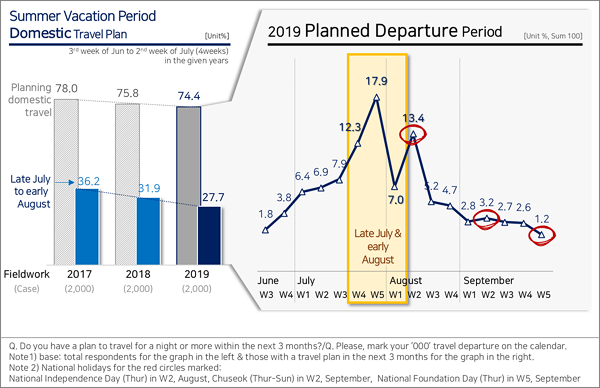
[Figure1] Domestic travel plan & Departure for Summer Vacation
■ Overseas travel-Peaked in the 2nd week of August around National Independence Day
Overseas travel planning increased from 37.2% in 2017, to 39.5% in 2018, to 40.1% in 2019, but its increase trend slowed down greatly [Figure 2]. In particular, departures during the 3 weeks from late July to early August rather declined in the past 3 years, from 7.8% to 8.4% to 6.7%, respectively.
Intended departures were the most for the 2nd week of August with 9.9%, followed by the 2nd week of September with Korean Thanksgiving holidays (or Chuseok), and the 5th week of September with the National Foundation Day, each at 9.6%. The departures were more than 1% point higher when there were holidays, than the 5th week of July (8.2%), the period with the largest departures amid late July and early August. The gap can become larger as travel planning can increase when it gets closer to Chuseok and the National Foundation day.
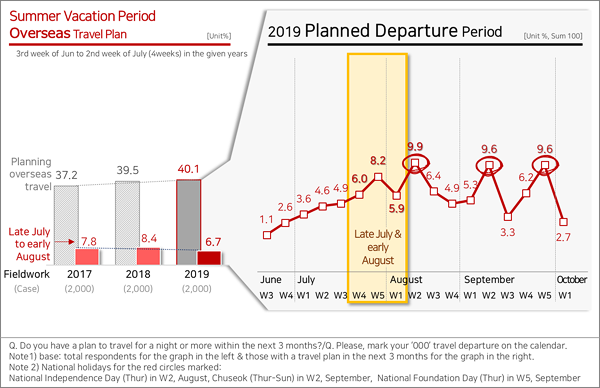
[Figure2] Overseas travel plan & Departure for Summer Vacation
The reason that the traditional travel periods of late July and early August is getting dispersed is because of travelers’ desire to use their holidays more efficiently. They want to maximize their holidays while using their annual leave from work less, by utilizing alternate holidays, etc. The same is not an exception for domestic travels that are done in relatively shorter terms. It is time to attract travelers who move under the motto `Time is gold`.
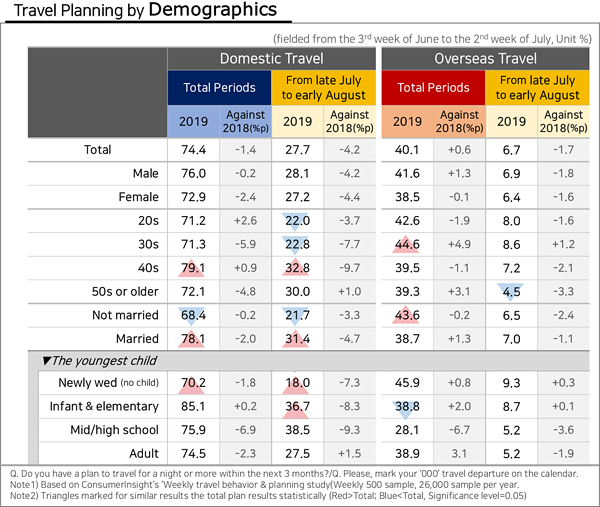
[Appendix] Travel Planning by Demographics
|