|
|
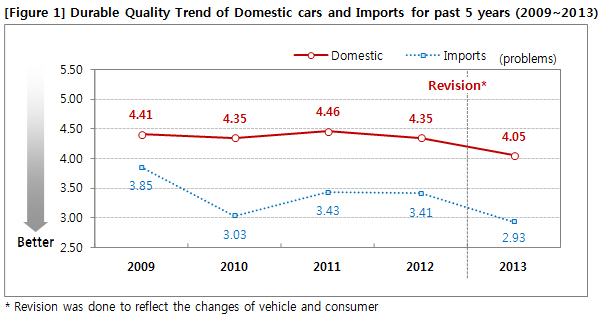
Imports surpassed Domestic cars with a large margin in Durable Quality, which counts the number of
problems of vehicle after 3 years from new car purchase. For past 4 years, Imports’ number of Durable
Quality problems on average had been less than the average of Domestic cars as well as Domestic top
brand. And the advantage has continued in this year also. Among Domestic cars, Hyundai has returned to
the top after 3 years, while BMW took the top with outstanding record in the comparison including 3 Import
brands. |
|
|
Durable Quality is calculated as average number of problems per vehicle (or average per 100 cars,
PPH ; Problems Per Hundred) from the number of quality problems (TGW-d: Things Gone Wrong-durability)
experienced by consumers while owning and using new car for 3 years from purchase. The lower the
number, the better the score. Automobile specialized research firm, Marketing Insight (www.mktinsight.
co.kr), conducted Durable Quality study with 7,442 consumers who had owned new car for 3 years from
purchase (purchased in 2010). In the study, Imports had 2.93 problems on average, which was 1.12 less
problems (112PPH) than Domestic cars (4.05 problems) [Figure 1]. |
|
 |
|
Although there had been changes in the gap of Durable Quality between Imports and Domestic cars, Imports had displayed 1 less problem (100PPH) on average in every year. It is a contrasting result with Domestic cars surpassing Imports in Initial Quality for the first time ( refer to: ‘Domestic cars ahead of Imported cars in
Initial Quality for the first time’), which uses same measuring scale. Just same as past years, Imports on average not only surpassed Domestic cars on average with a large margin, but had not-so-little gap with Domestic top (Hyundai at 3.72 problems). |
|
|
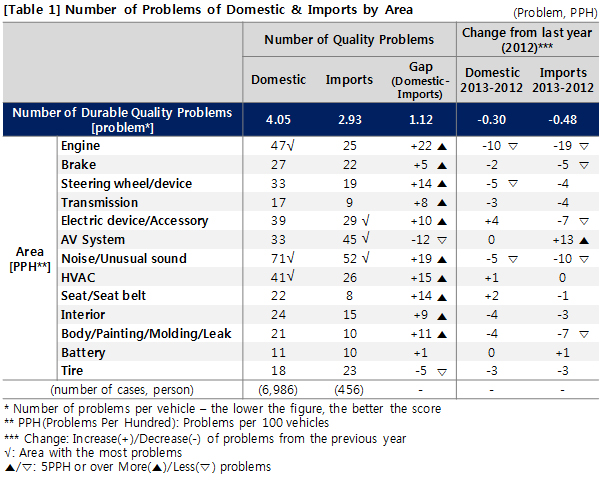
In order to find the areas from where Durable Quality gap between Domestic cars and Imports originated, the
number of problems were compared in 13 areas [Table 1]. In the result of 13 areas, the most problematic
area for Domestic cars and Imports in common was ‘Noise/Unusual sound’ (71PPH and 52PPH,
respectively) area. For Domestic cars, ‘Engine’ (47PPH) and ‘Heater/Air conditioning’ (41PPH) areas
followed after but for Imports, ‘AV system’ (45PPH) and ‘Electric device/Accessory’ (29PPH) areas followed
after. |
|
 |
|
|
Domestic cars had more problems than Imports in almost all areas. The most problematic areas in order
were ‘Engine’ (+22PPH), ‘Noise/Unusual sound’ (+19PPH) and ‘Heater/Air conditioning’ (+15PPH). On the
contrary, ‘AV system’ (-12PPH) and ‘Tire’ (-5PPH) had less problems than Imports. In almost all areas
except ‘AV system’, durability of Domestic cars were behind of Imports. |
|
|
When comparing this year’s result with last year, Domestic cars and Imports both had decreased number of
problems in most areas. The biggest exception includes ‘Engine’ area, in which Domestic cars and Imports
both had decreased largely (-10PPH and -19PPH, respectively), and ‘AV system’ area, in which Imports had
increased by 13PPH. That was caused by the revision of measuring tool that emphasized use convenience
rather than trouble or defect. Imports experienced disadvantage in Initial Quality from the revision of
questionnaire (Note 1) but in Durable Quality, it had advantage along with disadvantage. The number of
problems in ‘AV system’ had largely increased (+13PPH) but in ‘Engine’, it had largely decreased (-19PPH). |
|
|
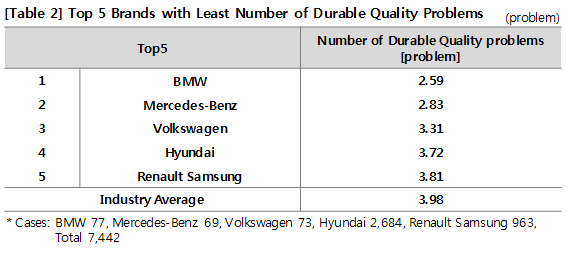
In the comparison among brands, BMW took the 1st place with 2.59 problems, followed by Mercedes-Benz
(2.83 problems), Volkswagen (3.31 problems), Hyundai (3.72 problems) and Renault Samsung (3.81
problems), in order in the top ranking group [Table 2]. The brands that were below Industry average or had
insufficient cases at below 60 were not presented. |
|
 |
|
|
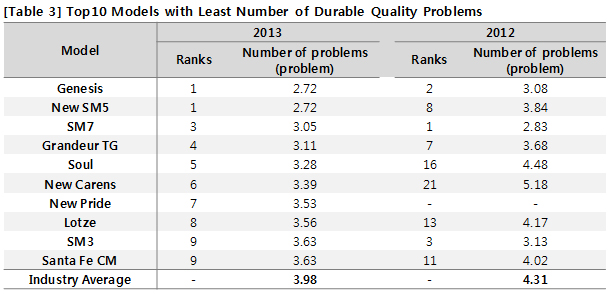
Among the Domestic models with over 60 cases, Top10 models with the least Durable Quality problem are
listed [Table 3]. Hyundai Genesis and Renault Samsung New SM5 took the tied top with 2.72 problems,
followed by SM7 (3.05 problems), which was the top in the previous year, at 3rd, Grandeur TG (3.11
problems) and Soul (3.28 problems). In the maker of Top10 models, Kia had the most with 4 models, while
Hyundai and Renault Samsung listed 3 models each. |
|
 |
|
|
|
|
 |
|
|
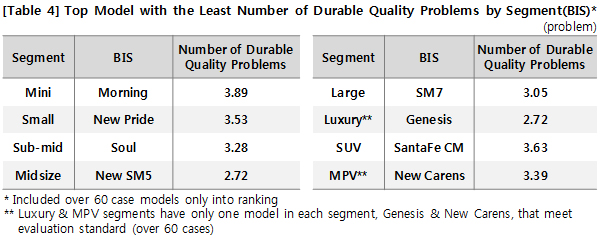
In the models with the least Durable Quality problem by segment [Table 4], Morning (3.89 problems) in Mini,
New Pride (3.53 problems) in Small, Soul (3.28 problems) in Sub-mid, New SM5 (2.72 problems) in Midsize,
SM7 (3.05 problems) in Large, Santa Fe CM (3.63 problems) in SUV and New Carens (3.39 problems) in
MPV took the 1st places in each segment. Kia took BIS (Best In Segment) in 4 segments, a half of entire 8
segments, while the rest were taken by Hyundai and Renault Samsung with 2 segments each. The reason
why Kia was superior in the comparison by segment while it was below Industry average in the comparison
by brand, can be guessed from the large difference in Durable Quality among the models in its umbrella. |
|
 |
|
Durable Quality is one of the biggest weaknesses of Domestic cars. The average of Domestic cars has never surpassed Imports during past 12 years. And in recent years, even Domestic 1st place brand had not caught up Imports on average. But we need to remember that Domestic cars surpassed Imports with not-so- little gap in the past. SM5 and SM3 from Renault Samsung sold before 2004 (subject to 2007 Durable Quality) had that achievement (refer to : White Paper on Korean Automobile Quality 2003 to 2007). This demonstrates that vehicle Durable Quality can be flexible as much as according to automaker’s intention. The main factors that lead Durable Quality of Domestic cars into inferiority include ‘Engine’, ‘Noise/Unusual sound’ and ‘Heater/Air conditioning’. Just with a focused management on these 3 areas, the gap with Imports can be narrowed largely. |
|
|
|
|
|
|
|
|
|
|
|
|
|
|
|
|
Marketing Insight Inc. has conducted ‘Automobile Quality and Customer Satisfaction Study’ in every July since 2001 with 100k consumers. The study results had been announced at the end of Sep. every year and published as ‘ White Paper on Korean Automobile Quality’, which includes 5 years trend analysis, in Nov. Also the results are utilized by domestic major automakers, auto-importers and automotive-related enterprises. |
|
Media release contents and ‘ White Paper on Korean Automobile Quality’ contents are listed on ‘AutoInsight’ ( www.autoinsight.co.kr), which is ‘Korean online automobile consumer reports’ developed by Marketing Insight Inc., and ‘ Auto Column’ of Daum Automobile section. Especially, ‘AutoInsight’ provides ‘One Page Report’ feature than can compare consumers’ product quality and service evaluations by model. |
|
|
|
|
|
|
|
|
|
|
|
|
|
|
[Research design & outline] |
|
|
|
|
|
|
|
|
|
• Research type: Syndicated study |
|
|
|
|
• Population: Nationwide Automobile user with e-mail account |
|
|
|
|
• Survey period: July 2013 |
|
|
|
|
• Data collection method: Online e-mail survey |
|
|
|
|
• Sample size: Total 101,701 respondents |
|
|
|
|
|
|
|
|
|
|
|
| |
| |
|
The results of this report were excerpted and summarized from the results of ‘Automobile Quality
and Customer Satisfaction Study’ conducted by Marketing Insight Inc. in every July since 2001.
All the rights for study contents, result and analysis deemed to Marketing Insight Inc. and cannot
be used for commercial purpose without prior written permission. More detailed information for
the study can be found at www.autoinsight.co.kr |
| |
|
|
|
|
|
|
|
|
|
|
Copyright ⓒ Marketing Insight. All rights reserved. Cannot be used for commercial purpose. | |
|
|
|
|
|
|
|
|
|
|
|
| |
|
|
|
| |
| |