|
|
Although the gap in evaluation for vehicle Feature·Performance·Design·Maintaining cost by consumers who
purchased new car within a year had been narrowed largely, the competitive edge of Imports was not as
certain as past years. By brand, the superiority of German cars was so strong that 4 German brands won
most of the top rankings. Among Domestic cars, Renault Samsung took the top title, followed by Hyundai. |
|
|
Automobile specialized research firm, Marketing Insight (www.consumerinsight.co.kr), asked the consumers
(7,811 persons) who purchased new car within a year about how much they were satisfied with the product
(TGR; Things Gone Right) in 8 areas including Feature·Performance·Design·Maintaining cost, as a part of
‘Automobile Syndicated Research’ (2013 sample size: 101,701 persons), which is conducted in every July.
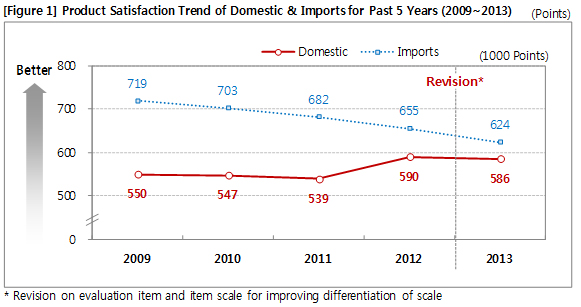
When looking into the calculated result of ‘Vehicle Product Satisfaction’ by dividing in Domestic and Imports,
Imports is still ahead of domestic but the trend had displayed not-so-little changes [Figure 1]. |
|
 |
|
|
The biggest change is from the revision of questionnaire applied from 2012, which resulted the narrowed gap
between Imports and Domestic cars after revision. The large gap around 150 points before the revision had
drastically reduced to 65 points after the revision (2012) and narrowed even further to 38 points in this year. |
|
|
Another change is that Imports’ Product Satisfaction had been in downward trend since 2009, while
Domestic cars had been in stagnated state. Generally there is a very close relation between vehicle price
and Product Satisfaction. More expensive car naturally has higher Satisfaction. In that aspect, nothing can
help the gap between Imports and Domestic cars and the recent declining of Imports appears to be caused
by steady increase of mid-to-low priced Imports that have relatively low Satisfaction. |
|
|
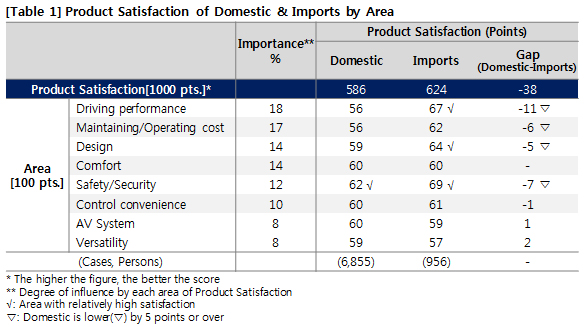
The 8 areas that compose Product Satisfaction were analyzed for their influences on Satisfaction by diving
in Domestic and Imports [Table 1]. Domestic cars and Imports users all considered ‘Driving performance’
importantly but in relatively sense, Domestic cars considered ‘Maintaining/Operating cost’ and ‘Comfort’
importantly, while Imports considered ‘Design’ and ‘Operation convenience’ importantly. |
|
 |
|
|
The area with the largest Product Satisfaction gap between Domestic-Imports was ‘Driving performance’, in
which Imports was higher by 11 points. This kind of gap is inevitable because Imports have many high-
performance models. Imports were dominant in most of other areas also such as ‘Safety/Security’ (7 points),
‘Maintaining/Operating cost’ (6 points), etc. Domestic cars surpassed Imports only in ‘Versatility’ (2 points). |
|
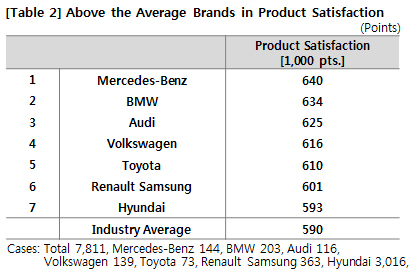
In the comparison by brand, Mercedes Benz took the 1st place with 640 points, followed by German brands in high rankings including BMW (634 points), Audi (625 points) and Volkswagen (616 points) [Table 2]. Japanese cars just saved face with Toyota at 5th place (610 points), while Lexus and etc. were excluded from comparison because of insufficient cases for analysis. Among Domestic brands, Renault Samsung took the lead with 601 points, followed by Hyundai (593 points). Renault Samsung had kept the domestic top for 4 consecutive years from 2008 in Product Satisfaction (formerly called ‘Product attractiveness’) but lost it to Hyundai in 2012 ( refer to: White Paper on Korean Automobile Quality 2008-2012) and returned to the throne in this year. |
|
 |
|
|
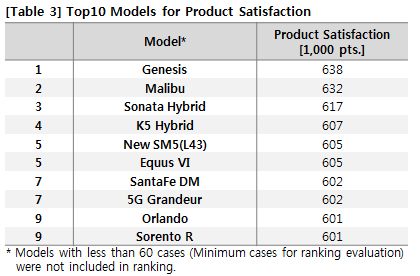
Among individual models of Domestic cars, Hyundai Genesis (638 points) had the highest Product
Satisfaction, followed by GM Korea Malibu (632 points), Hyundai Sonata Hybrid (617 points), Kia K5 Hybrid
(607 points), Renault Samsung New SM5 (605 points) and Hyundai Equus VI (605 points), in order [Table
3]. Along with Genesis, which takes the highest rankings in various product and quality indices, all the
midsize flagship models from 4 automakers and all the major hybrid models were included in the high
ranking group, which is noticeable. It can be learned that the Satisfaction for midsize cars in fierce
competition and high priced cars are high and new technology such as hybrid is highly accepted. |
|
 |
|
|
Product Satisfaction is the area of Domestic cars with the most salient inferiority. Not only it had been in
behind with a large gap but also the Domestic top brand hardly surpassed Imports average. In some aspect,
this is a natural phenomenon. It’s natural that Product Satisfaction of high priced premium brands is high.
Because nobody wants to pay a large amount of money on something with low Satisfaction. One of the most
obvious reasons for the rapidly reducing gap between Domestic-Imports is not because Domestic cars have
been improved but because mid-to-low priced Imports that compete with Domestic cars have increased and
the price gap has been reduced. |
|
|
When evaluating Product Satisfaction, the consumers’ consideration on price and cost is reflected as a
matter of course. It has to be the evaluation on ‘Performance for Price’ and ‘Features for Price’. In that
sense, the better evaluation score of Imports in ‘Maintaining/Operating cost’ area, which is one of the areas
with high importance, has a great significance. There are many disputes over the high-cost structure of
Imports, but Imports owners displayed better Satisfaction than Domestic cars. One of the reasons why many
consumers are currently switching from Domestic cars to Imports is the judgment on Imports’
‘Maintaining/Operating cost’ that is not expensive than expected. On top of that, current Import owners have
the possibility to switch to more expensive and larger Imports rather than returning back to Domestic cars. |
|
|
|
|
|
|
|
|
|
|
|
|
|
|
|
|
|
Marketing Insight Inc. has conducted ‘Automobile Quality and Customer Satisfaction Study’ in every July since 2001 with 100k consumers. The study results had been announced at the end of Sep. every year and published as ‘ White Paper on Korean Automobile Quality’, which includes 5 years trend analysis, in Nov. Also the results are utilized by domestic major automakers, auto-importers and automotive-related enterprises. |
|
Media release contents and ‘ White Paper on Korean Automobile Quality’ contents are listed on ‘AutoInsight’ ( www.autoinsight.co.kr), which is ‘Korean online automobile consumer reports’ developed by Marketing Insight Inc., and ‘ Auto Column’ of Daum Automobile section. Especially, ‘AutoInsight’ provides ‘One Page Report’ feature than can compare consumers’ product quality and service evaluations by model. |
|
|
|
|
|
|
|
|
|
|
|
|
|
|
[Research design & outline] |
|
|
|
|
|
|
|
|
|
• Research type: Syndicated study |
|
|
|
|
• Population: Nationwide Automobile user with e-mail account |
|
|
|
|
• Survey period: July 2013 |
|
|
|
|
• Data collection method: Online e-mail survey |
|
|
|
|
• Sample size: Total 101,701 respondents |
|
|
|
|
|
|
|
|
|
|
|
| |
| |
|
The results of this report were excerpted and summarized from the results of ‘Automobile Quality
and Customer Satisfaction Study’ conducted by Marketing Insight Inc. in every July since 2001.
All the rights for study contents, result and analysis deemed to Marketing Insight Inc. and cannot
be used for commercial purpose without prior written permission. More detailed information for
the study can be found at www.autoinsight.co.kr |
| |
|
|
|
|
|
|
|
|
|
|
Copyright ⓒ Marketing Insight. All rights reserved. Cannot be used for commercial purpose. | |
|
|
|
|
|
|
|
|
|
|
|
| |
|
|
|
| |
| |