|
|
Vehicle related stress of auto consumers, who purchased new car within a year, has been increasing, and
Domestic cars had more stress than Imports. The biggest stress in Domestic and Imports alike was ‘Worry
on time and cost for A/S service’, in which Imports had more stress. The least stressful brand was Toyota,
while GM Korea had kept the 1st place for 3 years in a row among Domestic cars. |
|
|
Quality stress counts the number of experienced stress because of car from consumers (7,811 persons)
who purchased new car within a year as a part of ‘Automobile Syndicated Research’ (2013 sample size;
101,701 persons). It is calculated as the average number of stress per car (or average per 100 vehicles,
SPH; Stress Per Hundred) experienced by consumers in 4 areas (20 items) including ‘Discomfort’, ‘Anxiety’,
‘Loss’ and ‘Anger’. Therefore, the lower the number, the better the score. Just as Initial quality and Durable
quality measure the quality in the number of experienced trouble·defect·problems, Quality stress measures
the number of dissatisfied experiences from experienced product and service, and therefore, it can be called
Overall Customer Satisfaction. |
|
|
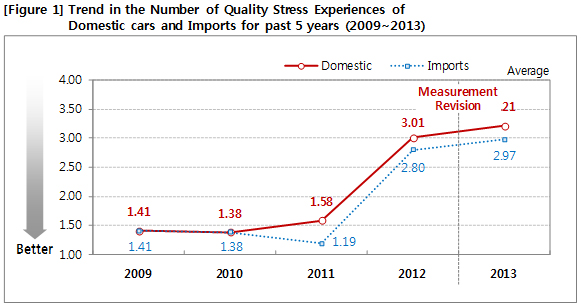
In the number of experienced stress from quality problem, Domestic cars had 3.21 stress, while Imports had
2.97 stress, displaying less stress of Imports [Figure 1]. |
|
 |
|
|
Domestic cars and Imports recoded tied score for 2 straight years in 2009 and 2010. But from 2011, Imports
started to lead ahead while having less number of stress than Domestic cars for 3 consecutive years.
Among Imports, Japanese cars with 2.52 stress boasted the dominant superiority in Quality stress aspect for
12 years in a row over European cars (3.03 stress) and America cars (3.42 stress). When considering the
not-so-good performance of Japanese cars in Product quality (Initial & Durable), this dominance of
Japanese cars came from Service quality. |
|
|
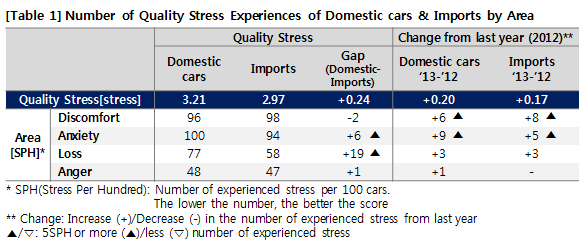
Domestic cars had around 20SPH more stress for 2 straight years, mainly because of ‘Loss’ area. It came
from the thoughts on ‘The car has less value than the price’ and ‘It costs more for fuel/maintaining than
expected’ in ‘Loss’ area. Even though there are lots of worries on Imports’ maintaining/managing expenses,
actually Domestic car owners worry more. The ones who get more stress from cost are Domestic car
purchasers, not Imports buyers. |
|
 |
|
|
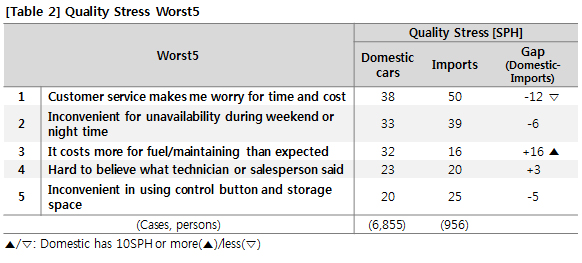
Worst 5 items in the percentage of experience among 20 stress items are presented on the basis of Domestic
cars. The most highly experienced stress by consumers was ‘A/S service makes me worry on time and
cost’, which took the most among Domestic cars and Imports alike. 1 out 2 Imports owners reported their
experiences like this, while Domestic car owners reached to 38% [Table 2]. |
|
 |
|
|
The following most mentioned stress after ‘A/S service makes me worry on time and cost’ include
‘Inconvenient for unavailability during weekend or night time’ and ‘It costs more for fuel/maintaining than
expected’. The item with the largest gap between Domestic cars and Imports was ‘It costs more for
fuel/maintaining than expected’ at 16 SPH, proving much larger burden on Domestic cars for daily
maintaining cost. One of the noticeable results is the very large dissatisfaction of consumers on A/S service
availability during weekend and night time. For manufacturers, providing A/S service during weekend and
night time is burdensome, due to much more cost. But in consideration for customer’s convenience with
priority, more proactive approach is required. |
|
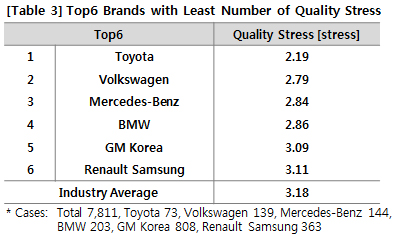
When looking into the brands with Quality stress below the Industry average [Table 3], Toyota took the 1st place with 2.19 stress, followed by Volkswagen (2.79 stress), Mercedes-Benz (2.84 stress) and BMW (2.86 stress), in order. Among Domestic brands, GM Korea took the 1st place for 3 years in a row with 3.09 stress, while Renault Samsung (3.11 stress), which had extremely poor performance in last year, showed a possibility of recovery ( refer to: White Paper on Korean Automobile Quality 2008-2012). By country, Japanese cars had firm dominance. But due to poor sales, many brands were unable to be included in the ranking. There are many things to learn from Japanese cars in customer stress management |
|
 |
|
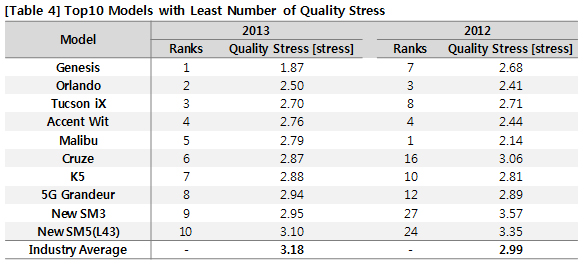
Top 10 models with less Quality stress than Industry average were selected [Table 4]. Hyundai Genesis took the 1st place with 1.87 stress, followed by GM Korea Orlando (2.50 stress) and Hyundai Tucson iX (2.70 stress). By maker, Hyundai advanced 4 models in Top 10, while 3 models from GM Korea, 2 models from Renault Samsung and 1 Kia model were included. When comparing with last year, New SM3 and New SM5 of Renault Samsung jumped from the very bottom to the high ranking group, making Renault Samsung escaping from last year’s depression and returning back to high ranking group ( refer to: White Paper on
Korean Automobile Quality 2008-2012). |
|
 |
|
Quality stress stands at the center of all quality indices ( refer to: [12-52] In the least stressful car, GM
Korea topped for 2 straight years), and has very close relations with Product quality and Service quality both, rendering it as ‘Main quality index’. Furthermore, in the sense of experienced quality by consumers, Quality stress can be called ‘Overall Customer Satisfaction that measures dissatisfied experiences from consumers’ experience’. One thing problematic is the limit on the target for current Quality stress as recent purchasers (within a year). If the target is expanded to 3 years ~ 5 years, more automakers and models can be included and therefore, it is expected to be ‘Overall Customer Satisfaction’ that has genuine representation. |
|
|
|
|
|
|
|
|
|
|
|
|
|
|
|
|
|
Marketing Insight Inc. has conducted ‘Automobile Quality and Customer Satisfaction Study’ in every July since 2001 with 100k consumers. The study results had been announced at the end of Sep. every year and published as ‘ White Paper on Korean Automobile Quality’, which includes 5 years trend analysis, in Nov. Also the results are utilized by domestic major automakers, auto-importers and automotive-related enterprises. |
|
Media release contents and ‘ White Paper on Korean Automobile Quality’ contents are listed on ‘AutoInsight’ ( www.autoinsight.co.kr), which is ‘Korean online automobile consumer reports’ developed by Marketing Insight Inc., and ‘ Auto Column’ of Daum Automobile section. Especially, ‘AutoInsight’ provides ‘One Page Report’ feature than can compare consumers’ product quality and service evaluations by model. |
|
|
|
|
|
|
|
|
|
|
|
|
|
|
[Research design & outline] |
|
|
|
|
|
|
|
|
|
• Research type: Syndicated study |
|
|
|
|
• Population: Nationwide Automobile user with e-mail account |
|
|
|
|
• Survey period: July 2013 |
|
|
|
|
• Data collection method: Online e-mail survey |
|
|
|
|
• Sample size: Total 101,701 respondents |
|
|
|
|
|
|
|
|
|
|
|
| |
| |
|
The results of this report were excerpted and summarized from the results of ‘Automobile Quality
and Customer Satisfaction Study’ conducted by Marketing Insight Inc. in every July since 2001.
All the rights for study contents, result and analysis deemed to Marketing Insight Inc. and cannot
be used for commercial purpose without prior written permission. More detailed information for
the study can be found at www.autoinsight.co.kr |
| |
|
|
|
|
|
|
|
|
|
|
Copyright ⓒ Marketing Insight. All rights reserved. Cannot be used for commercial purpose. | |
|
|
|
|
|
|
|
|
|
|
|
| |
|
|
|
| |
| |