|
The reason for not a few people moving to imported cars is because there is a unique strength in imported cars. Imported cars have a big lead in terms of Product quality, especially in attractiveness of product. On top of that, it was outstanding in Product reliability such as failure·problems, especially in durability. |
|
There are product capabilities division and reliability division in Product quality of car. Product capabilities are to be addressed that how users are satisfied with the design·feature·performance of the car, while reliability is to be addressed experienced defects or problems while using car which is divided into Initial quality and Durable quality. |
|
|
|
 |
|
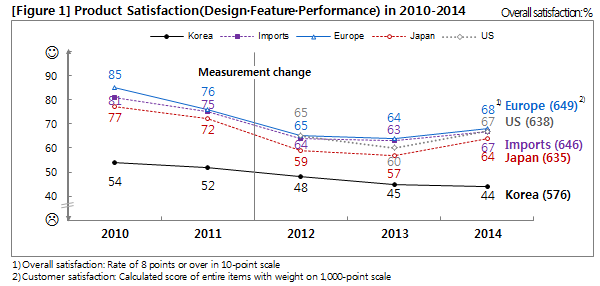
After asking preferred/not-preferred parts of design·feature·performance of new cars, a question was asked for how would grade them comprehensively on a 10-point scale. [Figure 1] is the results obtained as the Overall satisfaction rate from the percentage of consumers who graded 8 points or over. Since the study began in 2002, imported cars have maintained an overwhelming superiority against domestic cars, and the gap has been the largest among all the customer satisfaction indices. Recently (2011-2012) the gap had decreased to 15%p, but expanded to 23%p gap again in 2014. That’s because the Satisfaction rate of imported cars has increased, while that of domestic cars has declined. There was a big gap with Japanese cars that precedes the domestic cars by 20%p, which was the lowest among imported cars. The gaps among imported cars were not great, staying at 4%p gap. |
|
Similar to the Overall satisfaction rate, Europe was the highest in Products satisfaction of this year at 649 points, which was calculated at 1,000-point scale, followed by the United States (638 points), Japan (635 points) and Korea (576 points), in order. Korea had a great gap of over 70 points with Europe at the top. |
|
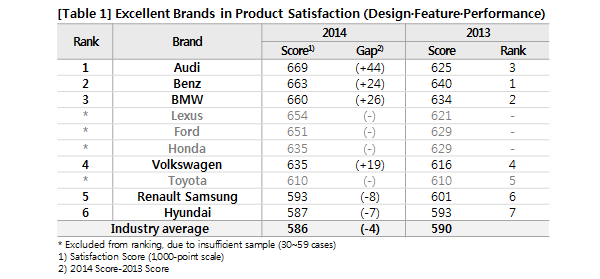
The brands with the industry average (586 points) or over score were selected as excellent brands in Product capabilities [Table 1]. Audi was third place last year but rose to first place with 669 points, while last year first place Benz stepped down to second place (663 points). Beside of those, BMW (660 points), Volkswagen (635 points), Renault Samsung (593 points), and Hyundai (587 points) were selected as the excellent brands with above the industry average scores. |
|
 |
|
Measurement of Product satisfaction is a summary of the evaluation on the 8 aspects of design·features·Performance. The lowest aspect of domestic cars compared to imported cars was ‘Driving performance’, and also lower in ‘Safety/security’ and ‘Maintaining/operating costs’. This tells us what domestic car has to complement as soon as possible. |
|
The most closely related index with auto sales among the Customer satisfaction indices is ‘Product satisfaction’. Sprint of imported cars is the effect from overwhelmingly competitive Product capabilities, and the not being narrowed gap between domestic·imports shows that there are some rooms still remaining for the march of imported cars. |
|
- Product Reliability: Initial Quality (number of respondents: 3,899 persons); The most important thing in reliability evaluation of automobile is how many failure·defects·problems experienced while using the car, and the experienced problems by consumer who purchased within 6 months is called ‘The number of Initial quality problems’. The results are presented in average ‘Cases’ of problems experienced by consumers. Therefore, smaller the number is better. |
|
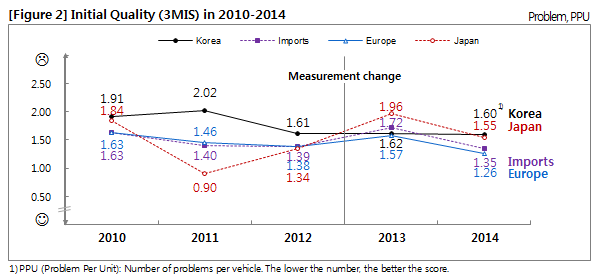
The number of Initial quality problems in 2014 study, that is the average of failure·defects·problems experienced by consumers was 1.60 problems for domestic cars, and 1.35 problems for imported cars [Figure 2]. While domestic cars had almost same number of problems as last year, imported cars had significantly improved by 0.37 problems. |
|
 |
|
Last year, domestic cars (1.62 problems) record the less number of problems than imported cars (1.72 problems) for the first time ever, and Hyundai had significantly higher achievement than imported cars at 1.43 problems. (Refer to: Domestic cars ahead of Imported cars in Initial Quality for the first time). Kia (1.62 problems) also surpassed imported cars. It is believed that the reversal of last year was caused by the result from the simultaneous action of good performances of Hyundai & Kia and special slump of imported cars.
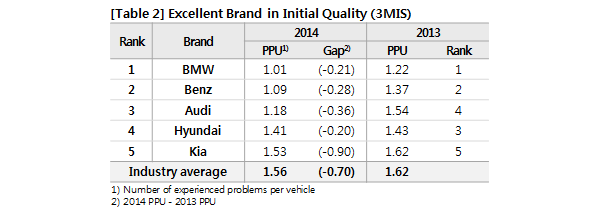
The excellent brands in Initial quality were selected on the basis of the number of problems less than Industry average (1.56 problems). BMW took the 1st place for 2 consecutive year with 1.01 problems again from last year (1.22 problems), followed by Benz (1.09 problems) and Audi (1.18 problems), dominating the top ranks by German premium cars [Table 2]. Among the domestic cars, Hyundai ranked at 4th with 1.41 problems and Kia ranked at 5th with 1.53 problems, being selected as excellent brands. Toyota and Lexus had the results of a top-level class, but excluded from official counting, due to insufficient number of base case.
|
|
 |
|
The Initial quality scores of Hyundai and Kia in Korean market measured by Marketing Insight displayed several times that that it is a leading indicator of JD Power Initial quality score (IQS) in the United States market. The record of Hyundai that had performed well in Korea last year appeared as the outstanding achievement in IQS of the United States this year. That Hyundai was reversed to imported cars again in this year suggests that there is a possibility of lower IQS outcome of Hyundai in next year. |
|
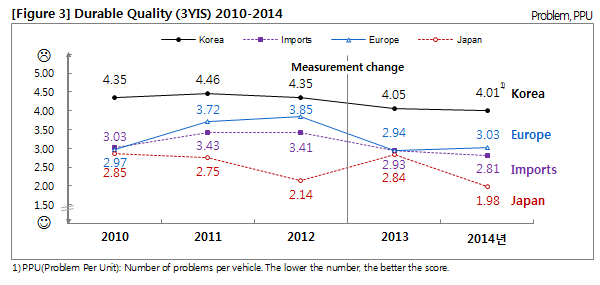
- Product Reliability: Durable quality (number of respondents: 6,153 persons); In the average number of Durable quality problems among the cars that had elapsed 3-year from the purchase as new car, imported cars was far ahead with 2.81 problems of domestic cars at 4.01 problems [Figure 3]. The average number of Durable quality problems of imported cars had been much fewer than not only domestic average but domestic 1st place for the past five years (2009 or later), and its dominance continued in this year also. Durable quality is a strength that supports the competitiveness of imported cars after Product capabilities. Superiority of Japanese cars was firm among the imported cars. |
|
 |
|
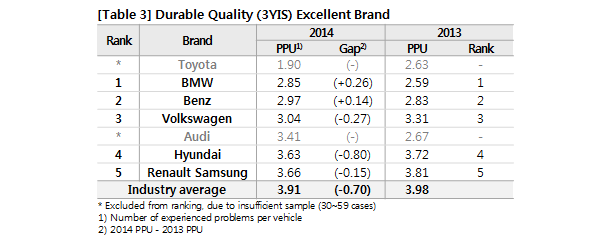
In the comparison that includes five domestic brands and 3 imported brands with 60 or over cases, BMW took the 1st place for 2 consecutive years with 2.85 problems, followed by Benz (2.97 problems) and Volkswagen (3.04 problems), taking the top ranks by a narrow margin [Table 3]. Hyundai (3.66 problems) and Renault Samsung (3.63 problems) were selected as excellent brands in Durable quality by recording less number of problems than the industry average (3.91 cases). |
|
 |
|
The problem here is the contradictory results of BMW at 1st place with 2.85 problems, while the average of imported cars is 2.81 problems. The reason is that the average of Japanese cars was far excellent at 1.98 problems that account Toyota, which was excluded from ranking with below 60 cases, and Lexus & Honda, which were not listed in the table because of below 30 cases, in the number of cases by brand. If the sale supported the back, Japanese brands have high possibility of dominating the top ranks.
The excellent quality of Japanese cars is well known all around the world, and is no exception in Korea. However, they are often removed from official comparison because of small sales volume that is not enough for comparative analysis. If Japanese cars can be sold more, domestic brands can be pressed to the below of industry average. If a new quality competition starts with good performance of Japanese cars, consumers have much to cheer.
|
|
The biggest weakness of the domestic cars in comparison with imported cars is Product quality evaluated by consumers. Satisfaction with owned vehicle of domestic consumers is far behind of imported car consumers’ satisfaction with owned vehicle. Important thing is that this is experience evaluation based on direct experience that affects significantly on the following behavior or decision. Quality of domestic cars does not give a positive experience to consumers. This can lead to a negative outcome in the coming competition. |
|
================================== |
|
|
|
|
|
|
|
|
|
|
|
|
|
|
|
|
Marketing Insight Inc. has conducted ‘Automobile Quality and Customer Satisfaction Study’ in every July from 2002 to 2014 with 100k consumers. The study results had been announced as press releases from the end of Sep. every year. Also the results are utilized by domestic major automakers, auto-importers and automotive-related enterprises.
|
|
Media release contents and ‘ Korean Automobile Quality Report’ contents are listed on
‘AutoInsight’ ( www.autoinsight.co.kr), which is ‘Korean online automobile consumer reports’
developed by Marketing Insight Inc., and ‘ Auto Column’ of Daum Automobile section. Especially,
‘AutoInsight’ provides ‘One Page Report’ feature than can compare consumers’ product quality
and service evaluations by model. |
|
|
|
|
|
|
|
|
|
|
|
|
|
|
[Research design & outline] |
|
|
|
|
|
|
|
|
|
• Research type : Syndicated study |
|
|
|
|
• Population : Nationwide Automobile user with e-mail account |
|
|
|
|
• Survey period : July 2014 |
|
|
|
|
• Data collection method : Online e-mail survey |
|
|
|
|
• Sample size : Total 101,821 respondents |
|
|
|
|
|
|
|
|
|
|
|
|
|
|
|
|
The results of this report were excerpted and summarized from the results of ‘Automobile Quality
and Customer Satisfaction Study’ conducted by Marketing Insight Inc. in every July since 2002.
All the rights for study contents, result and analysis deemed to Marketing Insight Inc. and cannot
be used for commercial purpose without prior written permission. More detailed information for
the study can be found at www.autoinsight.co.kr |
|
|
|
|
|
|
|
|
|
|
|
| |
Copyright ⓒ Marketing Insight. All rights reserved. Cannot be used for commercial purpose. |
|
|
|
|
|
|
|
|
|
|
|
|
|
|
|
|
|
|
|
|