|
The reason why the sprint of imported cars continues can be found in consumers’ evaluation, in which they are satisfied with imported cars higher quality than domestic cars. In Satisfaction for the recently purchased car, consumers switched to imports from domestic had the highest score, while consumers switched to domestic from imports had the lowest scores in the entire division. The consumers switched to domestic from imports had much dissatisfaction to the domestic cars and maker, and are willing to return to imported cars again, if they have enough money to spare. Their reactions are very important in the aspect that they have experienced both of imported cars and domestic cars. |
|
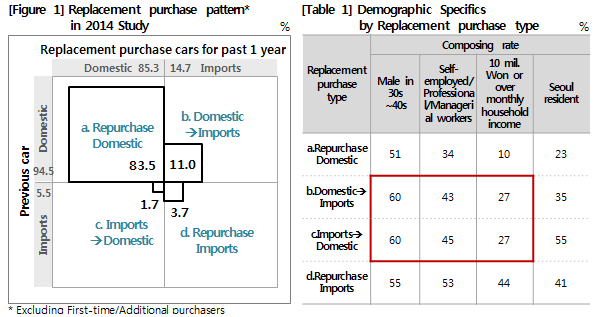
Marketing Insight, automotive specialist research firm (CEO: Kim, Jin-Kook), asked consumers what was the previously owned car (domestic or imports) and newly purchased car in the mega-scale Automobile Syndicated Study that has been conducted in July every year. And then asked how they were satisfied with the newly purchased car. In this year's study, the switching pattern of new car purchasers within past 1 year (5,582 persons) was as [Figure 1], while their demographic features are as [Table 1]. |
|
 |
|
Most of the consumers (83.5%) who replaced to new cars over the past 1 year was ‘Repurchase of domestic cars’, while about 1 in 10 people (11.0%) ‘Switched from domestic to imports’ [Figure 1]. And ‘Repurchase of imported cars’ and ‘Switched from imports to domestic’ were in a small number yet (3.7% & 1.7%, respectively). |
|
When looking at how different they are in terms of gender, age, occupation and income, ‘Repurchase of domestic cars’ had some differences with the rest of the groups. Consumers who currently own imported car or owned until recently had higher rates in ‘Male in their 30s and 40s’, ‘Self-employed/Professional/Managerial workers’, ‘10 million won or over monthly household income’ and ‘Seoul resident’ than ‘Repurchase of domestic cars’ group. |
|
The biggest difference among them was the average monthly household income. 10 million won or over monthly income was only 10% among the consumer ‘Repurchase of domestic cars’ but ‘Switched from domestic to imports’, and ‘Switched from imports to domestic’ were 27%, while ‘Repurchase of imported cars’ was at the highest to 44%. This indicates that the most influential variable to the purchase of imported cars is income. |
|
The most noticeable result in [Table 1] is that the ‘Switched from domestic to imports’ group and ‘Switched from imports to domestic’ group share nearly homogeneous nature. They had almost no difference in age, occupation and income aspects. However, the Seoul resident rate of ‘Switched from imports to domestic’ was greatly higher at 55% than that of ‘Switched from domestic to imports’ at 35%. That is because the penetration of imported cars started around Seoul and the replacement of those cars is also starting to happen in Seoul first. |
|
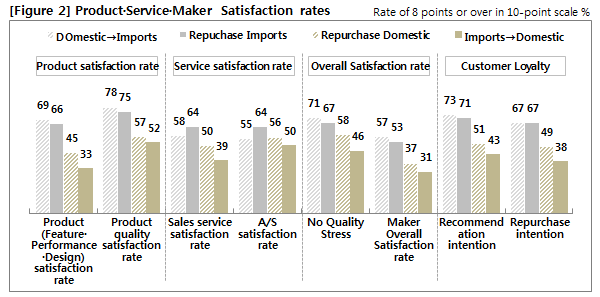
How they evaluate newly selected cars were examined with 6 Overall Satisfaction rates and 2 Loyalty indices [Figure 2]. First, in the satisfaction rates of 2 divisions that are related to quality including ‘Product capabilities’ (Feature, Performance, Design) and ‘Product quality’ (No trouble or problem), ‘Switched from domestic to imports’ was at the highest (69% & 78%, respectively), followed by ‘Repurchase of imported cars‘ with a slight gap (3%p each). |
|
‘Repurchase of domestic cars’ consumers had an over 20%p gap with Imports buyers, while ‘Switched from imports to domestic’ was even lower than this (33%, 52%, respectively). In overall perspective, Product satisfaction (Quality, Product capabilities) rates of Imports purchasers are much higher than the buyers of domestic cars. |
|
 |
|
When looking into service-related two divisions, ‘Repurchase of imported cars’ had the highest satisfaction rates in A/S and Sales (64%, respectively). In after-sales service, which is the weakest point of imported cars, ‘Repurchase of the domestic car’ only exceeds ‘Switched from domestic to imports’ with a narrow margin (1%p). The gap with each purchase pattern was least but still ‘Switched from imports to domestic’ was the lowest. |
|
To examine the Overall Satisfaction, ‘Quality Stress’ and ‘Maker Overall Satisfaction rate’ were compared. ‘Switched from domestic to imports’ had the highest satisfaction rates also in the Satisfaction rate for the ‘Stress-free’ and ‘Satisfaction rates for maker’ including Sales, Service and Quality, followed by ‘Repurchase of imported cars’, ‘Repurchase of the domestic car’ and ‘Switched from imports to domestic, in order. |
|
In the above result, the satisfaction of consumers who bought imported cars was higher than domestic cars in all the evaluation areas of 6 consumer satisfaction, while the consumers switched from Imports to domestic was most highly negative. They were negative not only to Product and Services but also to the company. |
|
The negative reaction of them does not seem to stay in the current dissatisfaction. They were asked ‘Whether or not to recommend’ the recently purchased car model to acquaintances and ‘Whether or not intend to repurchase’ the car from same maker next time in the 10-point scale. ‘Switched from domestic to imports’ and ‘Repurchase of imported cars’ showed around 70% ‘Recommended intention’ and ‘Repurchase intention’. On the other hand, ‘Repurchase of domestic cars’ was around 50% and ‘Switched from imports to domestic’ was only around 40%. This result displays that there is a close relationship between the current dissatisfaction and the selection in the future. |
|
At present time, it is not possible to know how ‘Switched from imports to domestic’ returned to the domestic again. However, they are extremely negative against the domestic car and maker they have selected with any reason, and likely to become more ‘Switched from domestic to imports’ than ‘Repurchase of the domestic car’ next time. It’s highly possible that they will spread the positive evaluation for imported cars and the negative attitude toward domestic cars based on the experiences of their own. The origin of the word, ‘Can’t drive domestic car after experiencing imported car’ could be them with high possibility. The good news is that they are only a few in number (1.7%) yet. |
|
Majority of consumers (83.5%) selected domestic car again. There would be no future unless taking care of them properly. |
|
================================== |
|
|
|
|
|
|
|
|
|
|
|
|
|
|
|
|
Marketing Insight Inc. has conducted ‘Automobile Quality and Customer Satisfaction Study’ in every July from 2002 to 2014 with 100k consumers. The study results had been announced as press releases from the end of Sep. every year. Also the results are utilized by domestic major automakers, auto-importers and automotive-related enterprises.
|
|
Media release contents and ‘ Korean Automobile Quality Report’ contents are listed on
‘AutoInsight’ ( www.autoinsight.co.kr), which is ‘Korean online automobile consumer reports’
developed by Marketing Insight Inc., and ‘ Auto Column’ of Daum Automobile section. Especially,
‘AutoInsight’ provides ‘One Page Report’ feature than can compare consumers’ product quality
and service evaluations by model. |
|
|
|
|
|
|
|
|
|
|
|
|
|
|
[Research design & outline] |
|
|
|
|
|
|
|
|
|
• Research type : Syndicated study |
|
|
|
|
• Population : Nationwide Automobile user with e-mail account |
|
|
|
|
• Survey period : July 2014 |
|
|
|
|
• Data collection method : Online e-mail survey |
|
|
|
|
• Sample size : Total 101,821 respondents |
|
|
|
|
|
|
|
|
|
|
|
|
|
|
|
|
The results of this report were excerpted and summarized from the results of ‘Automobile Quality
and Customer Satisfaction Study’ conducted by Marketing Insight Inc. in every July since 2002.
All the rights for study contents, result and analysis deemed to Marketing Insight Inc. and cannot
be used for commercial purpose without prior written permission. More detailed information for
the study can be found at www.autoinsight.co.kr |
|
|
|
|
|
|
|
|
|
|
|
| |
Copyright ⓒ Marketing Insight. All rights reserved. Cannot be used for commercial purpose. |
|
|
|
|
|
|
|
|
|
|
|
|
|
|
|
|
|
|
|
|