|
Fuel economy is one of the most important consideration factors while purchasing vehicle. On the flipside of the recent rapid growth of imported cars and explosive sales of diesel vehicles, there is fuel economy. Satisfaction of domestic car consumers for fuel economy was the lowest among all the satisfaction indices, leaving it in alarming level. The gap with imported cars was also the largest. The reason for dissatisfaction on fuel economy was not only the lower experienced fuel economy than expectation but also too lower level than official fuel economy. On top of that, they believe that the official fuel economy is intentionally exaggerated or overblown. |
|
Marketing Insight, an automotive specialist research firm (President: Kim, Jin-Kook), asked to the consumers who purchased new car within the past three years (23,491 persons) in 14th Automobile Syndicated Study (surveyed in July 2014) about the city fuel economy and highway fuel economy experienced from everyday driving of their own car (hereinafter referred to as ‘Experienced fuel economy’), and official composite fuel economy recognized by them (hereinafter referred to as ‘Recognized composite fuel economy’). And then, consumers’ attitude on fuel economy was figured out through dividing Experienced fuel economy by Recognized composite fuel economy (hereinafter referred to as ‘Experienced percentage’). |
|
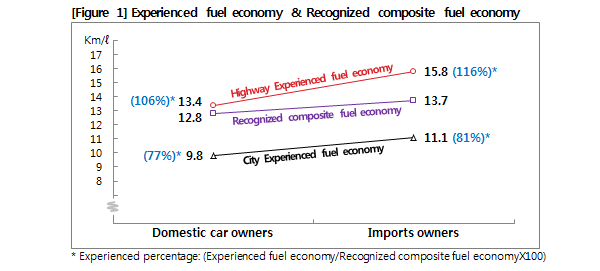
Owners of domestic cars recognized ‘Recognized composite fuel economy’ of their own car as 12.8km/ℓ on average, while import car owners recognized as 13.7km/ℓ. Imported car was higher by 7% [Figure 1]. Experienced fuel economy experienced by domestic car owners 9.8km/ℓ for city and 13.4km/ℓ for highway. Experienced percentage compared with Recognized composite fuel economy was 77% for city and 106% for highway. In other words, if Official composite fuel economy of domestic cars is 10km, the average mileage experienced by driver is 7.7km for city and 10.6km for highway. |
|
This result displays not only the ‘Experienced fuel economy’ of domestic car consumers not reaching the expectations, but also the ‘Experienced percentage’ having a large discrepancy with the official fuel economy claimed by automakers. |
|
 |
|
‘Experienced fuel economy’ of imported cars was 11.1km/ℓ for city and 15.8km/ℓ for highway, which were about 13% and 18%, respectively, higher than domestic cars. ‘Experienced percentage’ was also 81% for city and 116% for highway, which had not-so-little gaps with Domestic as 8.1km for city and 11.6km for highway under 10km/ℓ official composite fuel economy. |
|
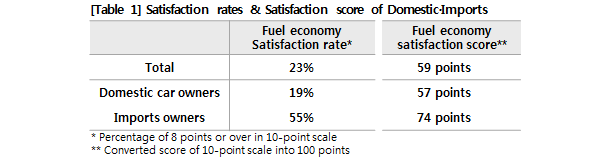
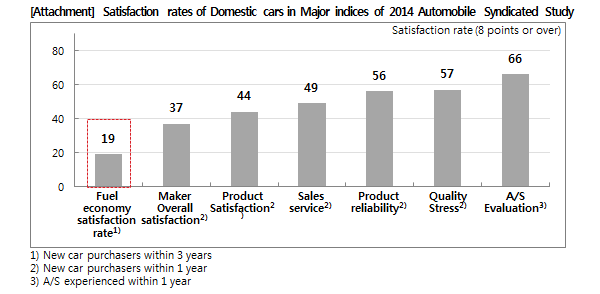
The result of overall satisfaction level for the fuel economy of their vehicles on 10 point-scale enables us to guess the consumers’ attitude on fuel economy [Table 1]. The percentage of 8 points or over in 10-point scale among domestic car consumers was only 19%, and the converted result into 100-point scale was just 57 points. That is the lowest score among all the surveyed indices of this year (Attachment: Satisfaction rates in major indices of 2014 Automobile Syndicated Study) and the most negative evaluation among the various satisfaction indices measured in Automobile Syndicated Study during the last 14 years. On the other hand, imported cars had more than half, 55% expressed satisfaction in fuel economy, having a big difference with domestic cars at 74 points on average. |
|
 |
|
Fuel economy is the only factor that can be displayed in number among the numerous attributes of vehicle, and always can be checked/evaluated/compared while directly linked to the economic burden always. When consumers find out intentional exaggeration or trickery of manufacturer, distrust and dissatisfaction of consumers become a matter of course. The reason for great satisfaction of consumers, who have migrated to imported cars from domestic car, and a lot of dissatisfaction of consumers, who have migrated to domestic car from imported cars, is estimated to be related with that (Refer to: Greatly satisfied is the consumers who switched from Domestic to Imported car!). |
|
------------------------------------------------------------------------------------------------------------------------------------------ |
|
 |
|
================================== |
|
|
|
|
|
|
|
|
|
|
|
|
|
|
|
|
Marketing Insight Inc. has conducted ‘Automobile Quality and Customer Satisfaction Study’ in every July from 2002 to 2014 with 100k consumers. The study results had been announced as press releases from the end of Sep. every year. Also the results are utilized by domestic major automakers, auto-importers and automotive-related enterprises.
|
|
Media release contents and ‘ Korean Automobile Quality Report’ contents are listed on
‘AutoInsight’ ( www.autoinsight.co.kr), which is ‘Korean online automobile consumer reports’
developed by Marketing Insight Inc., and ‘ Auto Column’ of Daum Automobile section. Especially,
‘AutoInsight’ provides ‘One Page Report’ feature than can compare consumers’ product quality
and service evaluations by model. |
|
|
|
|
|
|
|
|
|
|
|
|
|
|
[Research design & outline] |
|
|
|
|
|
|
|
|
|
• Research type : Syndicated study |
|
|
|
|
• Population : Nationwide Automobile user with e-mail account |
|
|
|
|
• Survey period : July 2014 |
|
|
|
|
• Data collection method : Online e-mail survey |
|
|
|
|
• Sample size : Total 101,821 respondents |
|
|
|
|
|
|
|
|
|
|
|
|
|
|
|
|
The results of this report were excerpted and summarized from the results of ‘Automobile Quality
and Customer Satisfaction Study’ conducted by Marketing Insight Inc. in every July since 2002.
All the rights for study contents, result and analysis deemed to Marketing Insight Inc. and cannot
be used for commercial purpose without prior written permission. More detailed information for
the study can be found at www.autoinsight.co.kr |
|
|
|
|
|
|
|
|
|
|
|
| |
Copyright ⓒ Marketing Insight. All rights reserved. Cannot be used for commercial purpose. |
|
|
|
|
|
|
|
|
|
|
|
|
|
|
|
|
|
|
|
|