|
Consumers’ satisfaction with fuel economy was the lowest among all the aspects of automobile, while the gap between domestic cars and imported cars was the greatest. By fuel type, gasoline had no significant difference between domestic and imported cars, while not a little difference in hybrids and a remarkable difference in diesel were found. The reason for diesel vehicles taking mainstream position is because of much better satisfaction than domestic cars. The 1st place brand in fuel economy satisfaction was Peugeot, while the 1st place model was the hybrid model of Toyota, Prius. GM Korea and Renault Samsung among domestic brands, and QM3 among domestic models, had high satisfactions. |
|
Automotive specialist research firm, Marketing Insight (President: Kim, Jin-Kook), asked the consumers (20,435 persons), who bought a new car within past 3 years, in 14th Automobile Syndicated Study (survey in July 2014) about the fuel economy satisfaction of their vehicles on 10-point scale. The result was converted to the score in 100-point scale to be used as satisfaction for fuel economy. |
|
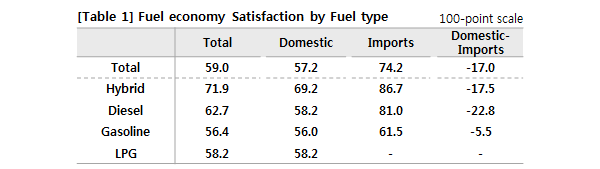
Overall average satisfaction for fuel economy was 59.0 points, while domestic cars scored 57.2 points and imported car scored 74.2 points. The average of imported cars was whopping 17.0 points higher than domestic cars [Table 1]. This is the largest gap between domestic and imported cars among all the satisfactions in product quality and service aspects. The biggest weakness of domestic cars in terms of consumers’ satisfaction for automobile can be fuel economy. |
|
 |
|
Satisfaction for the fuel economy had large differences depending on which fuel is being used. In overall, hybrid (71.9points) had the highest satisfaction for fuel economy, followed by diesel (62.7points), LPG (58.2 points) and gasoline (56.4 points). The overall order was in hybrid, diesel and gasoline but there was a large gap between domestic and imported cars. For Domestic cars, hybrid (69.2 points) was around 10 points higher than other fuel types such as diesel (58.2 points) and gasoline (56.0 points), but among imported cars, hybrid (86.7 points) and diesel (81.8 points) were over 20 points higher than gasoline (61.5 points).
In the gap between imported cars and domestic cars, the satisfaction of imported diesel vehicle was higher than domestic diesel cars by 22.8 points, while hybrid was 17.5 points higher. On the other hand, the difference in gasoline was only 5.5 points. The strength of Imported cars is in the hybrid and diesel than gasoline. Among them, the competitiveness of diesel is enormously strong.
|
|
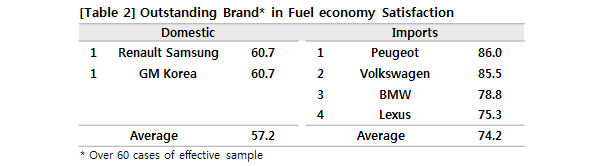
In fuel economy satisfaction by brand and model, comparing domestic and imported cars is in fact meaningless because of too large difference between them. Above the average brands in fuel economy satisfaction were selected as Outstanding brand after determining the average by dividing into imported cars and domestic cars [Table 2]. Among the domestic brands, Renault Samsung and GM Korea took joint first place with tied score of 60.7 points. Imported cars had four brands with over the average scores in which Peugeot took the first place with 86.0 points, followed by Volkswagen (85.5 points) at second place with a narrow margin. Following after were BMW (78.8 points) and Lexus (75.3 points).
|
|
 |
|
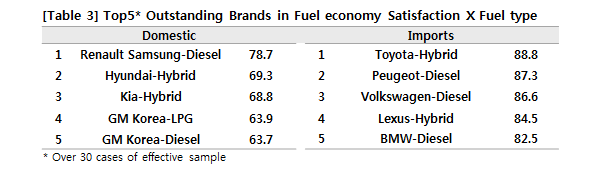
When considering the brand and fuel type at the same time, Diesel car from Renault Samsung was the highest at 78.7 points among domestic cars, followed by Hybrid cars from Hyundai and Kia (69.3 points & 68.8 points, respectively) [Table 3]. Among the imported cars, Toyota·Hybrid accounted for first place with the high score at 88.8 points, followed by Peugeot·Diesel?(87.3 points) and Volkswagen·Diesel (86.6 points). Top rankings of imported cars were mostly taken by Japanese hybrids and European diesel cars. Renault Samsung· Diesel had a significantly higher score among domestic cars but had a not-so-little gap with Top5 of imported cars. |
|
 |
|
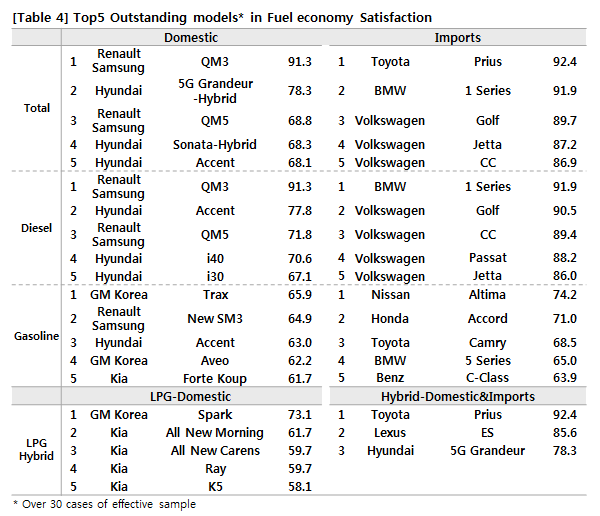
Among domestic models, the 1st place in fuel economy satisfaction was QM3 (91.3 points) from Renault Samsung, followed by 5G Grandeur·Hybrid (78.3 points) and QM5 (68.8 points), in order [Table 4]. Among the imported car models, Toyota Prius took the first place with 92.4 points, followed by BMW 1 series (91.9 points) and Volkswagen Golf (89.7 points). Top ranking models of Imported cars received 9 points or 10 points in 10-point scale from most of the consumers. One of the noticeable results is the high score of QM3, corresponding to the 3rd place in comparison with all the imported models. It is possible to know that the fuel economy of Renault engine is correctly recognized by domestic consumers also. |
|
 |
|
When summarizing Outstanding model by fuel type, the 1st place Outstanding model among Domestic·Diesel vehicle was QM3 (91.3 points), followed by Accent (77.8 points) at second place. Among Imported·Diesel vehicles, the first place was BMW 1 series (91.9 points) and the second place was Volkswagen Golf (90.5 points). Top rankings of domestic diesel cars were dominated by Renault Samsung and Hyundai models. Among Imported diesel vehicles, Volkswagen was noticeable by taking all the ranks between 2nd and 5th. |
|
Among Domestic·Gasoline cars, Trax from GM Korea was the 1st place at 65.9 points, followed by Renault Samsung New SM3 (64.9 points). In Imported?Gasoline cars, Nissan Altima was ranked first at 74.2 points, followed by Honda Accord at second place with 71.0 points and Toyota Camry (68.5 points) at third place, dominating the top ranks by Japanese midsize cars. |
|
In Domestic·LPG, GM Korea Spark (73.1 points) was ranked first, while Kia accounted for place from 2nd to 5th including All New Morning (61.7 points). In hybrid that combined the domestic and imports because of not many brands for comparison, Toyota Prius (92.4 points) and Lexus ES (85.6 points) accounted for the top ranks. |
|
Fuel economy is an attribute that consumers consider most importantly while purchasing a car. In the past, a larger car and attractive car in appearance were selected, but these days, fuel-efficient cars took the mainstream. Imported diesel vehicles are located at the center of this mainstream, and there is a reason for that. That is because they provide overwhelming satisfaction. Domestic manufacturers seem to have a certain degree of competitiveness in gasoline engines. However, there are not-so-little difference in hybrid, and a remarkable difference in diesel. Unless having a strength that can overcome over 20 points gap in fuel economy satisfaction, the leaning trend to Imports will continue. |
|
================================== |
|
|
|
|
|
|
|
|
|
|
|
|
|
|
|
|
Marketing Insight Inc. has conducted ‘Automobile Quality and Customer Satisfaction Study’ in every July from 2002 to 2014 with 100k consumers. The study results had been announced as press releases from the end of Sep. every year. Also the results are utilized by domestic major automakers, auto-importers and automotive-related enterprises.
|
|
Media release contents and ‘ Korean Automobile Quality Report’ contents are listed on
‘AutoInsight’ ( www.autoinsight.co.kr), which is ‘Korean online automobile consumer reports’
developed by Marketing Insight Inc., and ‘ Auto Column’ of Daum Automobile section. Especially,
‘AutoInsight’ provides ‘One Page Report’ feature than can compare consumers’ product quality
and service evaluations by model. |
|
|
|
|
|
|
|
|
|
|
|
|
|
|
[Research design & outline] |
|
|
|
|
|
|
|
|
|
• Research type : Syndicated study |
|
|
|
|
• Population : Nationwide Automobile user with e-mail account |
|
|
|
|
• Survey period : July 2014 |
|
|
|
|
• Data collection method : Online e-mail survey |
|
|
|
|
• Sample size : Total 101,821 respondents |
|
|
|
|
|
|
|
|
|
|
|
|
|
|
|
|
The results of this report were excerpted and summarized from the results of ‘Automobile Quality
and Customer Satisfaction Study’ conducted by Marketing Insight Inc. in every July since 2002.
All the rights for study contents, result and analysis deemed to Marketing Insight Inc. and cannot
be used for commercial purpose without prior written permission. More detailed information for
the study can be found at www.autoinsight.co.kr |
|
|
|
|
|
|
|
|
|
|
|
| |
Copyright ⓒ Marketing Insight. All rights reserved. Cannot be used for commercial purpose. |
|
|
|
|
|
|
|
|
|
|
|
|
|
|
|
|
|
|
|
|
|