|
Everyone is sympathetic to that fuel economy of imported cars is much higher than the domestic car. However, there is no information about consumers’ evaluation on how much specifically superior in detail under what conditions and situations. Experienced fuel economy of Imported cars was relatively stronger in highway, especially more advanced among diesel cars. Hybrid was similar, but among gasoline cars, domestic was superior. |
|
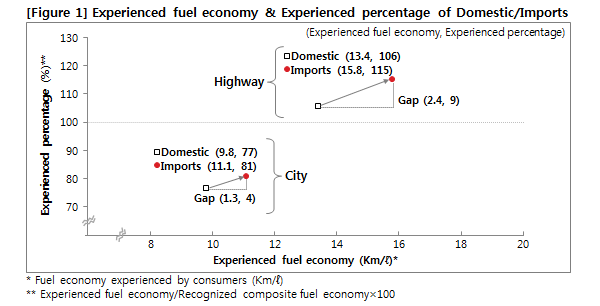
Automotive specialist research firm, Marketing Insight (President: Kim, Jin-Kook), asked the consumers (22,815 persons) who bought new car within past 3 years in 14th Automobile Syndicated Study (surveyed in July 2014) about official composite fuel economy (km/ℓ) of their own car (Recognized composite fuel economy), experienced fuel economy in city and experienced fuel economy in highway to determine the experienced percentage of fuel economy (Percentage of experienced fuel economy compared to official composite fuel economy) based on that. The experienced fuel economy and experienced percentage of domestic and imports in city and highway were as shown in [Figure 1]. |
|
 |
|
The average experienced fuel economy in city was 9.8km/ℓ for domestic and 11.1km/ℓ for imports, displaying Imports 1.3km/ℓ (13%) higher. In experienced percentage also, which was obtained through dividing by Recognized composite fuel economy, Imports was higher at 81% than domestic at 77%. On highway, Imports had 18% better experienced fuel economy at 15.8km/ℓ than domestic at 13.4km/ℓ. In experienced percentage, both were higher than city at 106% and 115%, respectively. The gaps in experienced fuel economy and experienced percentage on highway (2.4km/ℓ & 9%, respectively) were close to double of the gaps in city (1.3km/ℓ & 4%, respectively). In other words, the strength of imported car is in the fuel economy on highway. |
|
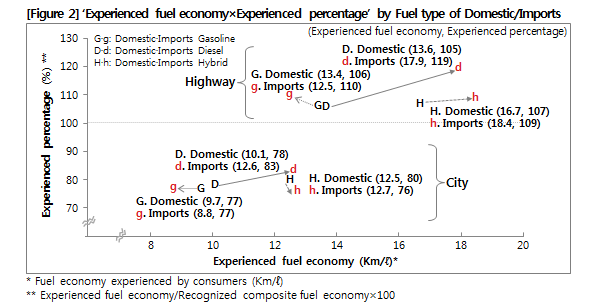
In order to investigate from where these differences come from in more detail, the results by fuel type such as gasoline, diesel and hybrid were summarized as in [Figure 2]. When looking into this, depending on fuel type and driving location, it is possible to know that there is a big difference between the imported cars and domestic car. |
|
 |
|
|
When simply summarizing the several distinctive contents indicated by the figure above; |
| 1. |
It is possible to know that there is a big difference between the highway and city fuel economy. Although it’s a matter of course, highway had better experienced fuel economy and better experienced percentage. In the case of domestic cars, hybrid was advanced in experienced fuel economy, while there was almost no gap between gasoline and diesel cars in average experienced fuel economy and experienced percentage. That’s probably because of the Mini & Small majority in domestic gasoline cars, but there was no difference on average. |
| 2. |
Unlike the domestic, imported cars were similar between diesel and hybrid, while gasoline was far away to the left. Imported gasoline cars appeared to have lower fuel economy than domestic gasoline. The main reason was because of the most models still with large displacement. |
| 3. |
The largest gap between domestic and imported cars was found in diesel on highway, followed by diesel in city. |
| 4. |
The smallest gap between domestic cars and imported cars was found in hybrid cars in city. City fuel economy of domestic hybrid was fairly competitive, unlike on highway. |
|
|
In overall look, imported cars’ strength included the excellent experienced fuel economy in diesel along with high experienced percentage. Experience fuel economy in city was 25% higher (12.6km/10.1km) and 32% higher (17.9km/13.6km) on highway than domestic cars, which makes it possible to guess that the competitiveness in those area is the source of imported diesel car boom.
|
|
The popularity of imported diesel cars can be seen in its sales volume. It was only 4% of the total sales volume in 2005 imported cars. But it had increased to 25% in 2010, and passed 2/3 of the entire imported cars (68%) in YTD of October 2014. Now 9 models out of top 10 selling models are diesel vehicles. When comparing the actual experienced fuel economy and experienced percentage, we can understand why consumers are enthusiastic to imported diesel vehicles. The frenzy of imported diesel car will continue unless the appropriate alternative is presented or such gap narrows rapidly.
|
|
================================== |
|
|
|
|
|
|
|
|
|
|
|
|
|
|
|
|
Marketing Insight Inc. has conducted ‘Automobile Quality and Customer Satisfaction Study’ in every July from 2002 to 2014 with 100k consumers. The study results had been announced as press releases from the end of Sep. every year. Also the results are utilized by domestic major automakers, auto-importers and automotive-related enterprises.
|
|
Media release contents and ‘ Korean Automobile Quality Report’ contents are listed on
‘AutoInsight’ ( www.autoinsight.co.kr), which is ‘Korean online automobile consumer reports’
developed by Marketing Insight Inc., and ‘ Auto Column’ of Daum Automobile section. Especially,
‘AutoInsight’ provides ‘One Page Report’ feature than can compare consumers’ product quality
and service evaluations by model. |
|
|
|
|
|
|
|
|
|
|
|
|
|
|
[Research design & outline] |
|
|
|
|
|
|
|
|
|
• Research type : Syndicated study |
|
|
|
|
• Population : Nationwide Automobile user with e-mail account |
|
|
|
|
• Survey period : July 2014 |
|
|
|
|
• Data collection method : Online e-mail survey |
|
|
|
|
• Sample size : Total 101,821 respondents |
|
|
|
|
|
|
|
|
|
|
|
|
|
|
|
|
The results of this report were excerpted and summarized from the results of ‘Automobile Quality
and Customer Satisfaction Study’ conducted by Marketing Insight Inc. in every July since 2002.
All the rights for study contents, result and analysis deemed to Marketing Insight Inc. and cannot
be used for commercial purpose without prior written permission. More detailed information for
the study can be found at www.autoinsight.co.kr |
|
|
|
|
|
|
|
|
|
|
|
| |
Copyright ⓒ Marketing Insight. All rights reserved. Cannot be used for commercial purpose. |
|
|
|
|
|
|
|
|
|
|
|
|
|
|
|
|
|
|
|
|
|