|
When looking at the purchase intention of consumers who are scheduled to buy a new car within two years, it is possible to detect that a ground breaking change is occurring in the automobile market. While the explosively increased imported car purchase intention rate has entered into adjusting period, slow performance of Hyundai·Kia and recovery of Renault Samsung are clearly visible. There is a large change in the popularity map of imported car brands, displaying Volkswagen at 1st place for the first time, steep rising trend of Benz and deepening depression of BMW and Japanese cars. |
|
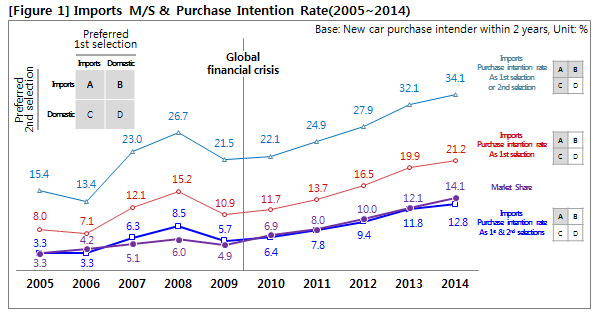
Marketing Insight, an automotive specialist research firm (President: Kim, Jin-Kook), asked 46,499 consumers, who are planning to buy a new car within next 2 years in the mega-scale Automobile Syndicated Study that has been conducted in July every year, to choose the most preferred model 1 and 2 in rank. In the result, 21.2% answered the imported cars as the first selection, while 34.1% answered as 1st or 2nd selection for imported cars, and 12.8% answered imported cars as 1st and 2nd selections [Figure 1]. Answers for domestic car as 1st and 2nd selections were 65.9%. In other words, one out of three car purchase intenders is considering the purchase of imported cars, while one out of five considers the purchase of imported cars as the highest priority, and one out of eight considers the purchase of imported cars as the only option. This is 1~2%p higher level than the previous year, but the rising trend was reduced to 1/2 of the level of the past few years. |
|
 |
|
The reducing margin of increase in purchase intention rate is worth to notice in this year's study results. Sharp rising trend after 2010 was reduced to about half of the level in the past year. Increase in market share is as it was but softening purchase intention is clearly visible. It is necessary to observe a little more to determine that it is a temporary phenomenon or any change occurring in the current. |
|
The reason why purchase intention rate is important is the close relation with the actual market share. Especially in the 6 years’ trend since the financial crisis of 2009, , the average gap between the rate of ‘Consider Imports only’ as the next car and actual market share of imported car was 0.6%p only. In this year's results, there was the largest gap of 1.3%p during the period between the market share at 14.1% and imported car only consideration rate at 12.8%. But it is clear that purchase intention rate is an excellent predictor of actual sales. |
|
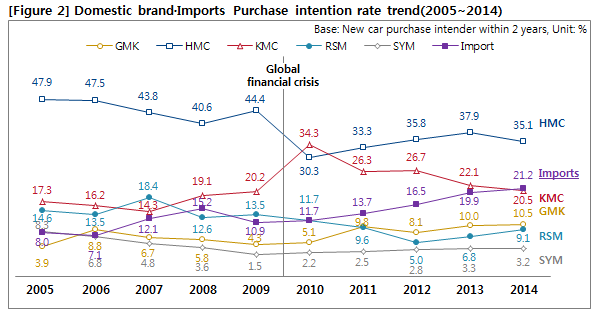
And then, how does the increase of purchase intention rate for imported cars affect the preference on domestic brand? The trend of change in the preference rate for imported cars and domestic brand (purchase intention rate for 1st selection) during the past decade is shown in [Figure 2]. The most notable thing in this year's result is that the purchase intention rate for imported cars as 1st selection (21.2%) went up to the second place next to Hyundai Motor (35.1%) for the first time ever. Kia Motors, which went up to the top in 2010 for the first time, became the third place with 20.5% after repeating backward driving. |
|
 |
|
In the trends of the past three years, Hyundai·Kia declined by 6.9%p from 62.5% in 2012 to 55.6% this year, while Imports increased by 4.7%p from 16.5% to 21.2%, and Renault Samsung had the rapid increase by 4.1%p from 5.0% to 9.1%. Along with the continuous advancing of Imported cars, there have been recovery of Renault Samsung and gradual rise of GM Korea. |
|
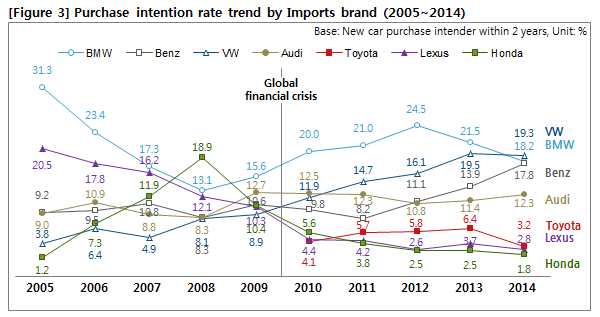
There is a considerable change in the preference rate among the imported brands. BMW has maintained the 1st place of preferred imported cars every year except in 2008 [Figure 3]. However, it repeatedly declined after the peak at 24.5% in 2012, and pushed to second place (18.2%) by giving up the first place in this year to Volkswagen (19.3%). 0.2%p decreased Volkswagen (from 19.5% to 19.3%) rose up to the top for the first time. It is thanks to the rise of Benz that brought the decline of BMW. Benz recorded the highest ever level at 17.8% by increasing 6.7%p from 2012, and closing with 0.4%p gap to BMW, which had declined by 6.3%p. The rise of Benz that was boosted by massive releases of new models has high possibility to claim 1st place in preference rate next year for the first time ever by surpassing declining BMW and stagnating Volkswagen. |
|
Audi has been in ups and downs in a narrow range of 11-13% since 2009, while Japanese brands, especially slump of Toyota is noticeable. The biggest victims from 4 Germany brands, sky-rocketing popularity of diesel cars and SUV appear to be Japanese cars. |
|
 |
|
Ups and downs of the imported car brand is seen as more serious than domestic brands. Although popularity is once soaring but it may fall on the floor. It is obvious in the case of Honda, which rose to first place in 2008 preference rate at 18.9% but became 1.8% this year, falling down to the 1/10th level in just six years. It can be known that the success and failure of a particular model is directly connected to the success and failure of the overall brand. |
|
There seems to be a huge ground breaking change in the automobile market. In a large scope, the advance of imported cars is continuing and makes it possible to forecast reaching the two-fold level at 27% in 2020 ( Refer to: Imported car will take 27% by 2020 at latest). And the 1 st wave damage from the growth of imported cars can migrate to Hyundai·Kia from Renault Samsung with high possibility. Also the competition among German cars may be deployed in a new aspect, while the popularity of diesel cars and importance of fuel economy are expected to continue for the time being. Also whether the advance of Benz that enjoys new car effect from the series of new car releases could lead into 1 st place in preferred Imports or not is a matter of interest. |
|
Current automobile market is moving in dynamic way. It's passing a upheaval period, in which no one can see an inch ahead. Who knows well the mind of consumer and meet their needs will determine the future. |
|
================================== |
|
|
|
|
|
|
|
|
|
|
|
|
|
|
|
|
Marketing Insight Inc. has conducted ‘Automobile Quality and Customer Satisfaction Study’ in every July from 2002 to 2014 with 100k consumers. The study results had been announced as press releases from the end of Sep. every year. Also the results are utilized by domestic major automakers, auto-importers and automotive-related enterprises.
|
|
Media release contents and ‘ Korean Automobile Quality Report’ contents are listed on
‘AutoInsight’ ( www.autoinsight.co.kr), which is ‘Korean online automobile consumer reports’
developed by Marketing Insight Inc., and ‘ Auto Column’ of Daum Automobile section. Especially,
‘AutoInsight’ provides ‘One Page Report’ feature than can compare consumers’ product quality
and service evaluations by model. |
|
|
|
|
|
|
|
|
|
|
|
|
|
|
[Research design & outline] |
|
|
|
|
|
|
|
|
|
• Research type : Syndicated study |
|
|
|
|
• Population : Nationwide Automobile user with e-mail account |
|
|
|
|
• Survey period : July 2014 |
|
|
|
|
• Data collection method : Online e-mail survey |
|
|
|
|
• Sample size : Total 101,821 respondents |
|
|
|
|
|
|
|
|
|
|
|
|
|
|
|
|
The results of this report were excerpted and summarized from the results of ‘Automobile Quality
and Customer Satisfaction Study’ conducted by Marketing Insight Inc. in every July since 2002.
All the rights for study contents, result and analysis deemed to Marketing Insight Inc. and cannot
be used for commercial purpose without prior written permission. More detailed information for
the study can be found at www.autoinsight.co.kr |
|
|
|
|
|
|
|
|
|
|
|
| |
Copyright ⓒ Marketing Insight. All rights reserved. Cannot be used for commercial purpose. |
|
|
|
|
|
|
|
|
|
|
|
|
|
|
|
|
|
|
|
|