|
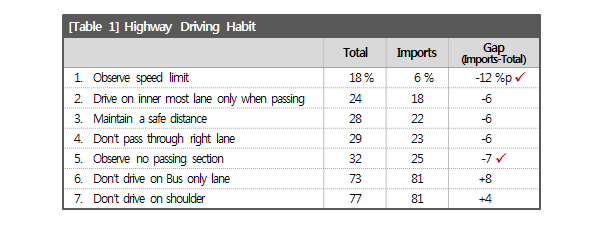
Ignoring regulations by drivers might exceed the limit. More than 70% of drivers do not observe speed limit, lane driving method, a safe distance and passing method on highway. Drivers who observe the speed limit was 18% of the total, whereas in the case of imported cars, it was only 6%. One in 2 drivers had a tendency of speeding, and the reason for not keeping the regulation appeared to be the mind for speeding. |
|
Marketing Insight, an automobile specialized research firm ( www.consumerinsight.co.kr), asked the driving habits on highway to the drivers (1,158 people) in 2014 Automobile Syndicated Study with seven questions. As a result, it was found that only 30% or fewer drivers observed most of the regulations [Table 1]. ‘1. Observe speed limit’ had the lowest compliance rate at 18%, with ‘2. Drive on inner most lane only when passing’ at 24%, ‘3. Maintain a safe distance’ at 28%, ‘4. Don’t pass through right lane’ at 29%, ‘5. Observe no passing section’ at 32%, displaying fewer than 1 out of 3 drivers keeping each of the regulations. The responses on ‘7. Don’t drive on shoulder’ and ‘6. Don’t drive on Bus only lane’ only had over 70% compliance, making it possible to know that they don’t usually observe unless it is clearly noticeable violation. |
|
 |
|
The tendency of not abiding by the regulation was more severe among imported car drivers, in overall. 3 or over out of 4 imported car drivers appeared to violate other than ‘Don’t drive on shoulder’ and ‘Don’t drive on Bus only lane’. Especially, only 6% answered to observe ‘speed limit’, displaying only 1/3 of domestic cars’ compliance rate (18%). Compliance rates for other regulations also were 6~7%p lower than domestic cars, while the reason for not observing them appeared to be for speeding. It’s not too much to say that lots of imported car drivers don’t care to choose any means and methods for speeding. However, noticeable violations such as ‘Don’t drive on shoulder’ and ‘Don’t drive on Bus only lane’ were tended to be more restrained. |
|
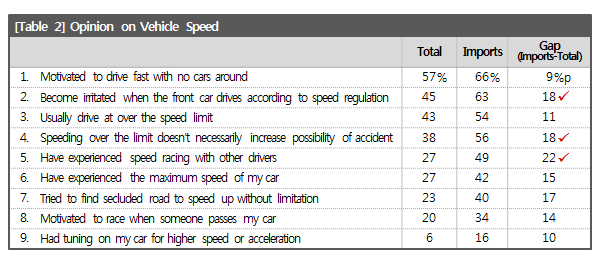
Nine questions were presented to discover what the drivers think in the flip-side of speeding [Table 2]. ‘1. Desire to drive fast with no cars around’ was the highest at 57%, followed by ‘2. Become irritated when the front car drives according to speed regulation’ at 45%, displaying the desire for speeding by about a half. ‘3. Usually drive at over the speed limit’ at 43% and ‘4. Breaking speed limit doesn’t necessarily increase possibility of accident’ at 38% displayed dangerous behavior and perception in relation with speeding by two out of five people. |
|
 |
|
Such a tendency was more severe among imported car drivers. They had 9%p or higher response than domestic car drivers in all nine questions, among which ‘5. Have experienced speed racing with other drivers’ had the largest gap. Among imported cars, one out of two (49%) answered to have experience, being 22%p higher than the Total (27%). In addition, ‘2. Become irritated when the front car drives according to speed regulation’ by 18%p, ‘4. Speeding over the limit doesn’t necessarily increase possibility of accident’ by 18%p and ‘8. Motivated to race when someone passes my car’ by 14%p higher, making it possible to glimpse the risky behavior and thinking of imported car drivers. |
|
Speeding is the cause of most frequent and dangerous accidents undisputed. However, thoughts and behavior of the drivers have a great distance from that. Especially, imported car drivers not only do not observe the law & regulations but have the attitude of not recognizing even the danger of speeding. Not so-little number of drivers regard road as the game arena for speed racing rather than seeing as the passage for transportation. |
|
There are well-observed laws and not-observed laws by drivers. While prohibition on Drunk driving·Highway shoulder driving·Reverse driving are well observed, Mobile phone use·Speed limit are not observed mostly ( Refer to: Safe Driving 1: Traffic Regulation Violation - The Most Frequent Violation is ’Cellphone Use’). Depending on how to conduct crackdown and punishment, the ignoring and the compliance of laws and regulations can be determined. Speeding is the starting point of all violations of the laws and regulations. Continuously treating speeding strictly will be able to obtain the effect of enforcing all laws and regulations. |
|
================================== |
|
|
|
|
|
|
|
|
|
|
|
|
|
|
|
|
Marketing Insight Inc. has conducted ‘Automobile Quality and Customer Satisfaction Study’ in every July from 2002 to 2014 with 100k consumers. The study results had been announced as press releases from the end of Sep. every year. Also the results are utilized by domestic major automakers, auto-importers and automotive-related enterprises. |
|
Media release contents and ‘ Korean Automobile Quality Report’ contents are listed on
‘AutoInsight’ ( www.autoinsight.co.kr), which is ‘Korean online automobile consumer reports’
developed by Marketing Insight Inc., and ‘ Auto Column’ of Daum Automobile section. Especially,
‘AutoInsight’ provides ‘One Page Report’ feature than can compare consumers’ product quality
and service evaluations by model. |
|
|
|
|
|
|
|
|
|
|
|
|
|
|
[Research design & outline] |
|
|
|
|
|
|
|
|
|
• Research type : Syndicated study |
|
|
|
|
• Population : Nationwide Automobile user with e-mail account |
|
|
|
|
• Survey period : July 2014 |
|
|
|
|
• Data collection method : Online e-mail survey |
|
|
|
|
• Sample size : Total 101,821 respondents |
|
|
|
|
|
|
|
|
|
|
|
|
|
|
|
|
The results of this report were excerpted and summarized from the results of ‘Automobile Quality
and Customer Satisfaction Study’ conducted by Marketing Insight Inc. in every July since 2002.
All the rights for study contents, result and analysis deemed to Marketing Insight Inc. and cannot
be used for commercial purpose without prior written permission. More detailed information for
the study can be found at www.autoinsight.co.kr |
|
|
|
|
|
|
|
|
|
|
|
| |
Copyright ⓒ Marketing Insight. All rights reserved. Cannot be used for commercial purpose. |
|
|
|
|
|
|
|
|
|
|
|
|
|
|
|
|
|
|
|
|
|