|
Although there are many consumers who want to buy domestic cars when the performance and price of domestic cars and imported cars are same, the people who want to buy domestic cars only were just one out of 10 people. More than a half of people either prefer Imported cars or have no regard between domestic and imported, if the performance and price are same. Consumers were very sensitive to the price with about 1/2 of them changing their preference to the other car on 500k won price difference. However, more than a half of imported car purchase intended consumers stuck to imported cars, even with 2 million won cheaper price of domestic cars. |
|
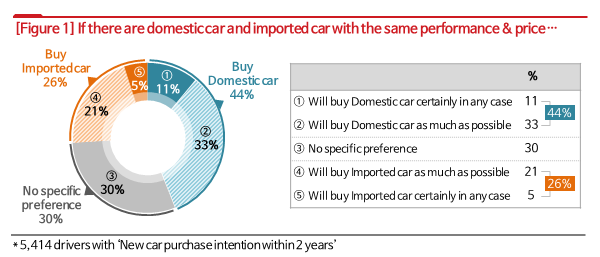
Marketing Insight, an automobile specialized research firm ( www.consumerinsight.co.kr), asked to 5,414 vehicle drivers with new car purchase intention within two years in the 2014 Automobile Syndicated Study about "Which one do you want to buy, either imported cars or domestic cars, if performance and price are the same. As a result, ‘Will buy a domestic car’ (certainly in any case & As much as possible) was at 44%, while ‘Will buy imported car’ appeared at 26% and ‘No specific preference’ at 30% [Figure 1]. There were not many consumers who have a great affection for the country of origin as shown in ‘Will buy a domestic car certainly in any case’ at 11% and ‘Will buy imported car certainly in any case’ at 5%. On the basis of imported cars, it is possible to know that more than a half of the entire purchase intenders (56%) are not resistant to imported car purchase, if the conditions are identical. |
|
 |
|
If the price condition changes, what will happen to the purchase intention? As one of the most important consideration factors, 50% of the purchase intenders were found to change their mind by the price difference of 500k won ( Refer to: ‘Low carbon bonus system’ getting sympathy with careful approach). In this study, when the most highly purchase intended model was 500k won higher, 50% of consumers had changed their mind to the second model. |
|
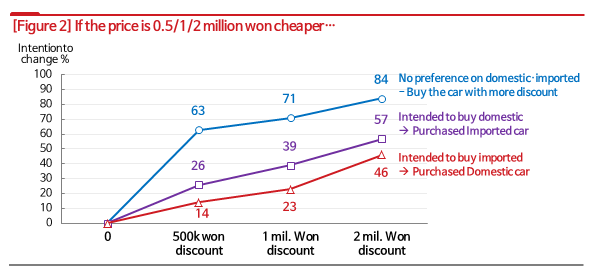
Price elasticity was significantly different depending on the preference for either domestic or imported. Imported car intenders changed their mind to domestic, when the discount amount of domestic car was at 500k won by 14%, at 1 million won by 23% and at 2 million won by 46% only, which is less than a half [Figure 2]. On the other hand, domestic car purchase intenders were higher by 10%p or over than imported cars, by 26% with the discount amount at 500k won, by 39% at 1 million won and by 57% at 2 million won. The most highly affected case by price was ‘No specific preference for domestic or imported’. Almost two-thirds of them at 63% were willing to change at the price difference of 500k won, and went up to 71% at 1 million won and to 84% at 2 million won. The most sensitive people with the price difference were the ‘Consumers with no specific preference for domestic or imported’, while the least affected was the ‘Imported car preferred’ with the ‘Domestic car preferred’ in the middle. |
|
 |
|
This survey results provide some important implications. Firstly, in any case, the consumer who wants to buy a domestic car was only one out of 10 people. On the other hand, the half of vehicle purchase intenders have no resistant feeling to imported cars. And, 50% of the vehicle purchase intenders will change their mind with 500,000 won higher or lower price, while the half of imported car purchase intenders won’t give up imported cars when domestic car is 2 million won cheaper. |
|
Now it’s right to let go of the expectation on the domestic automobile consumers for their favor to domestic car. Not a few people want to buy imported cars even at expensive price. If the imported cars start the earnest price competition, the territory of the domestic cars will be narrowed significantly without a choice. They should equip with the competitive edges in both performance and price. |
================================== |
|
|
|
|
|
|
|
|
|
|
|
|
|
|
|
|
Marketing Insight Inc. has conducted ‘Automobile Quality and Customer Satisfaction Study’ in every July from 2002 to 2014 with 100k consumers. The study results had been announced as press releases from the end of Sep. every year. Also the results are utilized by domestic major automakers, auto-importers and automotive-related enterprises. |
|
Media release contents and ‘ Korean Automobile Quality Report’ contents are listed on
‘AutoInsight’ ( www.autoinsight.co.kr), which is ‘Korean online automobile consumer reports’
developed by Marketing Insight Inc., and ‘ Auto Column’ of Daum Automobile section. Especially,
‘AutoInsight’ provides ‘One Page Report’ feature than can compare consumers’ product quality
and service evaluations by model. |
|
|
|
|
|
|
|
|
|
|
|
|
|
|
[Research design & outline] |
|
|
|
|
|
|
|
|
|
• Research type : Syndicated study |
|
|
|
|
• Population : Nationwide Automobile user with e-mail account |
|
|
|
|
• Survey period : July 2014 |
|
|
|
|
• Data collection method : Online e-mail survey |
|
|
|
|
• Sample size : Total 101,821 respondents |
|
|
|
|
|
|
|
|
|
|
|
|
|
|
|
|
The results of this report were excerpted and summarized from the results of ‘Automobile Quality
and Customer Satisfaction Study’ conducted by Marketing Insight Inc. in every July since 2002.
All the rights for study contents, result and analysis deemed to Marketing Insight Inc. and cannot
be used for commercial purpose without prior written permission. More detailed information for
the study can be found at www.autoinsight.co.kr |
|
|
|
|
|
|
|
|
|
|
|
| |
Copyright ⓒ Marketing Insight. All rights reserved. Cannot be used for commercial purpose. |
|
|
|
|
|
|
|
|
|
|
|
|
|
|
|
|
|
|
|
|
|