|
When the customers are not satisfied with the current automaker, they will select other automakers for the next car. Domestic car owners have a high loyalty, and therefore, they seek an alternative when they have dissatisfaction. Imported car is one of the leading alternatives. Imported car owners look for other imported brands even though they are satisfied with the current automakers. Hence, actions to improve customer satisfaction are even more urgently required for the domestic automakers. |
|
Marketing Insight, a research firm specialized in automotive industry, asked 20,622 ‘new car purchasers, who have ‘new car purchase intention within two years’, about the next ‘purchase intended brand/model’ in 2014 annual Automobile Syndicated Study. The result was compared with the Overall Satisfaction for the automaker of owned model (Evaluation for ‘the Satisfaction level on the automaker’ when considering sales · service · quality of the company comprehensively on 10-point scale), which classified 8 points or over as ‘Satisfied’, 6-7 points as ‘Neutral’ and 5 points or under as ‘Dissatisfied’. |
|
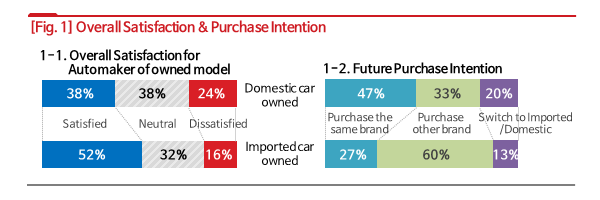
The results of Overall Satisfaction and future purchase intention from all the targeted respondents were organized by dividing into domestic owners and imports owners [Fig. 1]. The satisfaction of purchase intenders who own domestic car for the automaker had not a little difference with the satisfaction of imported car owners. While 38% domestic car owners are ‘Satisfied’, 38% are ‘Neutral’ and 24% are Dissatisfied’. The overall satisfaction of imported car owners for automaker was high at 52%, 32% and 16%, respectively [Fig. 1-1]. More than a half of Imported car owners (52 %) were satisfied, displaying not so little gap with domestic (14%p), while domestic had more ‘Dissatisfied’ by 8%p at 24% than imports at 16%. |
|
 |
|
Domestic car owners and imported car owners expressed even larger gap in purchase intention. While almost a half of domestic owners (47%) displayed the opinion for repurchase intention of the same brand, imported car owners indicates a re-purchase intention at 27% only, and 60% wanted to buy other imported brands [Fig. 1-2]. This indicates that imported car owners are eager to buy other imported brands despite of high satisfaction. The intention to switch from domestic cars to imports, or from imported cars to domestic was not relatively high in number (20% & 13%, respectively). |
|
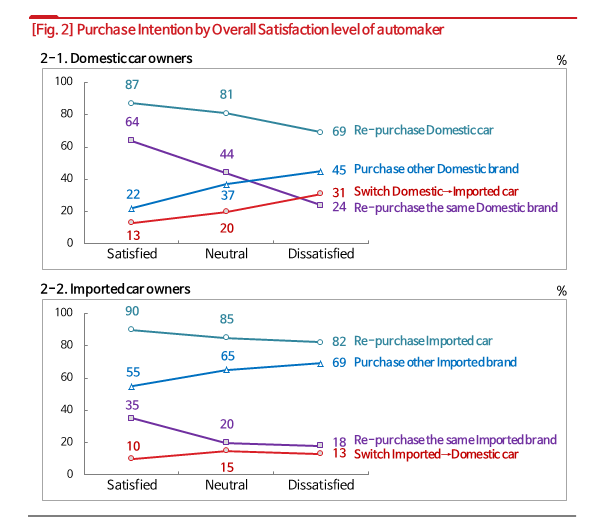
In order to identify the relationship between the purchase intention and Overall Satisfaction for automaker, a comparison was made by dividing into ‘Satisfied’, ‘Neutral’ and ‘Dissatisfied’ groups. In the case of a domestic car owner, high satisfaction was led to re-purchase as a matter of course, while low satisfaction had high switching intention to other brands [Fig. 2-1]. The most radical change depending on the lowering degree of satisfaction was seen in re-purchase intention for the same brand. Re-purchase intention was at 64% in the case of ‘Satisfied’ but plunged to 24% in the case of ‘Dissatisfied’ group. On the other hand, the purchase intention of other domestic brand (23%p) and the purchase intention of imported vehicles (18%p) had increased significantly, exceeding the re-purchase of the same brand. This indicates that the dissatisfaction in Overall Satisfaction for the automaker in the case of domestic car owners is led to the tremendous loss of market opportunity. |
|
 |
|
Imported car owners were significantly different from the domestic. Re-purchase intention of overall imported cars was high, and only 13% wanted to switch to domestic even with dissatisfaction. Even in the case of Satisfied, a majority (55%) wanted to purchase other imported brands, while re-purchase of the same brand reached just 35%. This indicates that imported car owners, regardless of whether they are satisfied or not, are always peeping other imported cars and low satisfaction does not necessarily make the imported car owners choose domestic brands for the next car. That’s because Imported cars have many eager-to-drive models from consumers’ view-point, as they are still in market introduction stage with many brands and a variety of models and prices. |
|
Over the past decade, the satisfaction for automaker had steadily declined, while dissatisfaction had increased ( Refer to: Dissatisfaction & Disappointment on Automakers are Getting Larger). Lowering possibility to buy a car from the same automaker with higher dissatisfaction is a matter of course. However, the selection remains in the same area is quite different from leaving to the different area. While the consumers of domestic cars switch to imported cars in the case of having dissatisfaction, imported car owners, regardless of having satisfaction or dissatisfaction, are looking for other imported cars. Domestic automakers with relatively more number of dissatisfied customers are likely to lose these customers forever. Because they are migrating into the imported car market, which has low probability of coming back. On the other hand, imported car customers have less risk with high possibility to revolve around in the imported car market regardless of the degree of satisfaction. Systematic management to improve customer satisfaction of automaker is a more compelling matter to domestic automakers. |
|
================================== |
|
|
|
|
|
|
|
|
|
|
|
|
|
|
|
|
Marketing Insight Inc. has conducted ‘Automobile Quality and Customer Satisfaction Study’ in every July from 2002 to 2014 with 100k consumers. The study results had been announced as press releases from the end of Sep. every year. Also the results are utilized by domestic major automakers, auto-importers and automotive-related enterprises. |
|
Media release contents and ‘ Korean Automobile Quality Report’ contents are listed on
‘AutoInsight’ ( www.autoinsight.co.kr), which is ‘Korean online automobile consumer reports’
developed by Marketing Insight Inc., and ‘ Auto Column’ of Daum Automobile section. Especially,
‘AutoInsight’ provides ‘One Page Report’ feature than can compare consumers’ product quality
and service evaluations by model. |
|
|
|
|
|
|
|
|
|
|
|
|
|
|
[Research design & outline] |
|
|
|
|
|
|
|
|
|
• Research type : Syndicated study |
|
|
|
|
• Population : Nationwide Automobile user with e-mail account |
|
|
|
|
• Survey period : July 2014 |
|
|
|
|
• Data collection method : Online e-mail survey |
|
|
|
|
• Sample size : Total 101,821 respondents |
|
|
|
|
|
|
|
|
|
|
|
|
|
|
|
|
The results of this report were excerpted and summarized from the results of ‘Automobile Quality
and Customer Satisfaction Study’ conducted by Marketing Insight Inc. in every July since 2002.
All the rights for study contents, result and analysis deemed to Marketing Insight Inc. and cannot
be used for commercial purpose without prior written permission. More detailed information for
the study can be found at www.autoinsight.co.kr |
|
|
|
|
|
|
|
|
|
|
|
| |
Copyright ⓒ Marketing Insight. All rights reserved. Cannot be used for commercial purpose. |
|
|
|
|
|
|
|
|
|
|
|
|
|
|
|
|
|
|
|
|
|