|
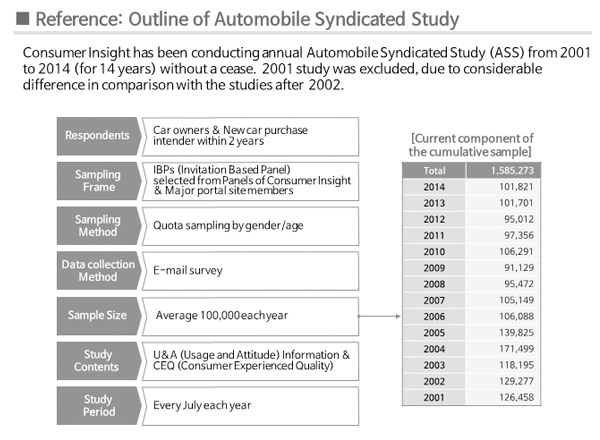
Consumer Insight, a research firm specialized in consumer evaluation (former Marketing Insight, CEO, Kim, Jin-Kook), announced the results of ‘Consumer Evaluation Study for Automobile Quality and Customer Satisfaction’ (total 14 waves, surveyed 1.58 million people) that has been carried out every year for past 14 years from 2001 to 2014 ( Refer to: Automobile Syndicated Study Overview). Consumers are more and more disappoined and dissatisfied with the automotive industry, especially in the case of domestic cars. In the most aspects of products and services, imported cars is to lead the domestic cars that has become the attracting force for consumers to imported cars. If there is a hope in the domestic cars, the gap is becoming narrower and imported cars are behind in A/S area. When the market defending force increases because of improper move of competitor, consumers are more regrettable. This is going to increase more disappointment and dissatisfaction. |
|
1) Satisfaction for automaker
|
|
 |
|
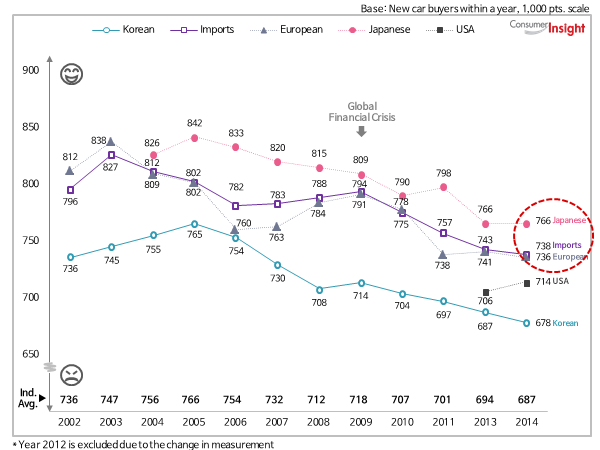
The consumers who purchased new car within one year were asked for how much they were satisfied with ‘the automaker in overall (including the quality / service / marketing)’, and company satisfaction was calculated based on this in a 1000-point scale. As a result, the average overall satisfaction of the automotive industry had declined continuously since 2005 (except in 2009 with Global Financial Crisis) to 687 points in 2014. It's a world-low score.
|
|
In terms of country of origin, there are several distinctive features. Satisfaction of the domestic automakers is over 50 points lower than imported cars. Although it was recently narrowed, there is still a large gap of 60 points (678 points for domestic, imported at 738 points). Domestic cars had never been ahead of Japanese cars at the first place for the past 13 years, and not even the average of the European and American cars. Domestic car had always been the lowest, while Japanese had been at top-level and Europe in between.
|
|
From this, we know that the factors making customer buy a car are different from the factors satisfying purchased customer. Domestic automakers are still attractive enough for customers to buy a car, but they have not obtained the hearts of purchased consumers. It can be known that there is a problem with the post-sales customer relationship management.
|
|
2) Product satisfaction
|
|
 |
|
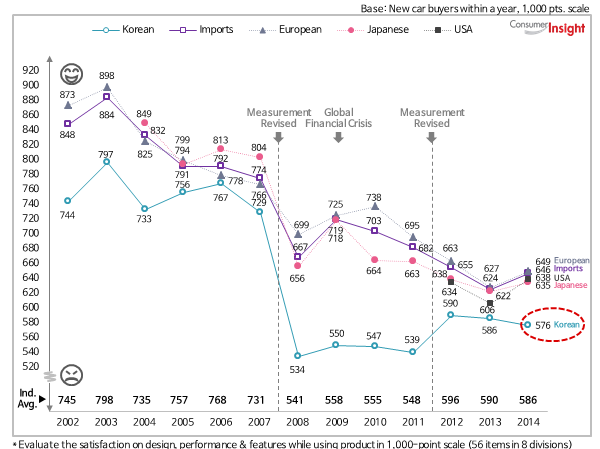
The evaluation of automobile consumers who purchased new cars within 1 year on feature · performance · design (1000-point scale) is the Product satisfaction. Product satisfaction measurement went through several changes in the measurement method because of difficulty in measurement, but it had always been the area with the largest gap between imported cars and domestic cars. In other words, the satisfaction of imported car buyers for features · performance · design of new car has always been much higher. In 2014, domestic had decrease by 10 points, while imported cars increased by 22 points, widening the gap between two back to 70 points level. While Domestic new car release was minimal, imported brands and models are more diversified, seemingly widening the gap by enlarging the selection range.
|
|
In terms of country of origin, domestic cars had never ahead of imported cars for the past 13 years as in the company satisfaction. The ranking order of Europe, Japan and Korea is clear. Korean cars had always been the lowest, while Japanese cars had been between European and Korean cars. We can see that European cars in product aspect and Japanese cars in post-sales customer relationship management, have big lead ahead of domestic cars.
|
|
3) Number of automobile quality problems (Average number of problems per car)
|
|
 |
|
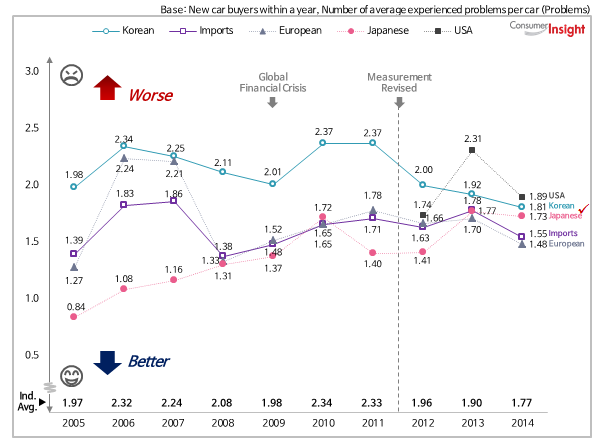
Number of automobile quality problems is the ‘number of problems’ from defect · flaw · trouble that were experienced by consumers after purchase within one year from vehicle purchase (average 6 months in use), and thus not as good as high number. Automobile quality problem is not a factor that generates new consumer by directly stimulating purchase intention like product satisfaction, but rather a factor to make the consumer leave by giving them inconvenience · dissatisfaction · cost burden.
|
|
The number of quality problems of domestic cars had been at 2 or more level per car until 2011, which had always been 0.5 problem higher than imported cars. For the last three years since 2012, it had decreased significantly to 1.81 problems for domestic cars in 2014, narrowing the gap with imported cars by 1.55 problems.
|
|
While Japanese cars’ have weak Product satisfaction that attracts purchase, European cars’ Product satisfaction is high with fewer problems. Domestic is lagging behind to imported cars in both areas. In the momentum of European cars, the physical properties such as the attractive product and stable quality are working largely.
|
|
4) Sales satisfaction (SSI)
|
|
 |
|
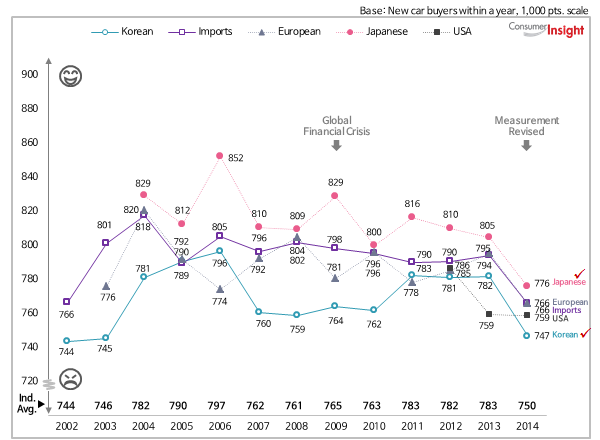
Sales Satisfaction (SSI) evaluates sales service experienced at the time of purchase and post-sales customer care by consumers who purchased new car within one year, and calculates them in 1,000-point scale.
|
|
Sales service for the past 13 years had been continuously dominated by imported cars. The gap was once huge at over 60 points with domestic cars but it had been narrowed to within 20 points in 2014 (imports at 766 points, domestic at 747 points). By the country of origin, Japanese cars among imported cars had maintained the top level for 10 years by leading the European cars.
|
|
A significant portion of Sales service satisfaction is affected by the post-sales customer care that has a reason for a particular management. Post-sale Customer care has a great impact not only on Sales satisfaction but also on quality problem evaluation and A/S evaluation. The greatest force for high evaluation of Japanese cars in the service field comes out of the post-sale customer care.
|
|
5) A/S Service Satisfaction (CSI)
|
|
 |
|
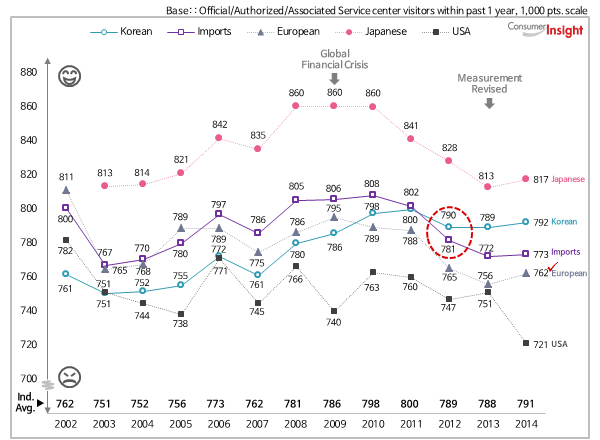
A/S Service Satisfaction (CSI) calculates the evaluation of the consumers who had A/S service in the service center of owned car company within the past year on ‘Reservation, Procedure, Results, Cost’ in 1,000 points scale. By 2008, imported car A/S service had surpassed domestic cars with considerable difference, but since then, the gap had rapidly decreased. The reason includes rapid improvement of domestic cars’ A/S service and stagnation of imported cars. In 2012, a reversal happened for the first time and that was the first case of imported cars lagging behind of domestic cars among the many areas of quality and customer satisfaction.
|
|
The width of the reversal had increasingly expanded and in 2014, domestic surpassed import cars by more than 20 points (domestic at 792 points, imports at 773 points). Problem of imported cars’ A/S service is not the problem of entire imported cars but of European and American cars. Japanese cars had continuously maintained the highest level since 2003 with the gap that domestic cars are not even close to near, which had recently narrowed slightly but still holding 25 points advantage. It should be the benchmarking target by Korea and Europe.
|
|
Negative evaluation on imported cars’ A/S can be a serious obstacle soon to European and American cars. Imported car A/S has emerged as one of the biggest reasons for abandoning purchase consideration of imported cars. It’s the second place factor next to Price. Imported cars’ A/S service has already been revealed as the only and the biggest weakness of imported cars. Proactive responding is required.
|
|
Conclusion
Imported cars are far ahead of domestic cars in most areas of the quality and customer satisfaction. The European cars in Product aspect and Japanese cars in terms of customer satisfaction are dominant. In other words, European cars in product and Japanese cars in service have dominated over domestic cars.
|
|
Currently, Korean imported car market is led by European cars, while Japanese are unable to escape from the slump. One thing to be noted is that Japanese cars have no weak point unlike the European cars. Consumers’ evaluation on the European cars’ A/S is harsh. That is the point where European cars should pay a special attention.
|
|
================================== |
|
 |
|
|
Copyrightⓒ Consumer Insight All rights reserved. Cannot be used for commercial purpose.
|
|