|
Rising trend of imported cars is because there are some own strengths. Consumers believe for sure that imported cars have comparative advantages in product aspect. On the other hand, it is vulnerable in terms of cost and service. However in overall aspect, imported cars has surpassed the domestic car in the value for money. The consumers who intend to buy imported cars see a large gap in the value for money. It is natural to see consumer following good performance for price. |
|
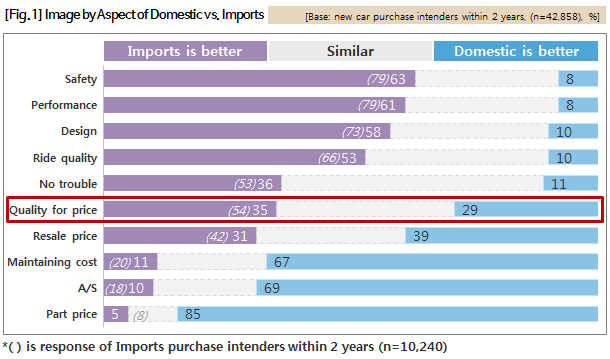
In order to figure out the relative competitive advantage between imported cars and domestic cars from consumers’ viewpoint, 42,858 purchase intenders of new car within two years were asked to choose which side is better in 10 aspects such as product, quality and cost. As a result, domestic cars were evaluated as excellent in cost, while imported cars were evaluated as excellent in products and quality aspects |
|
Three out of five purchase intenders chose ‘imported car in the better’ product features such as safety, performance and design, while only one in ten chose ‘domestic car as better’ one [Figure 1]. On the other hand, in cost and A/S, most chose domestic cars with the overwhelming dominance. The response to choose ‘imported cars for better’ parts price, A/S and vehicle maintenance costs aspects were only 5%, 10% & 11%, respectively. In other words, the unrivaled superiority was clearly divided into imported cars in product aspect and domestic cars in cost and service. |
|
 |
|
On the whole, almost all the people admit that imported cars cost much money as seen in ‘parts price’. Imports purchase intenders were also not much different from that, but they clearly took a side for Imports in ‘Safety’ and ‘Performance’ (79% each). They considered that Imports have more merits (13%p or over), and tended to evaluate the weakness at somewhat lower level. |
|
In order to compare relative superiority or inferiority between products and cost, people were asked about how was ‘quality for price’ aspect. In the result, more people chose imported cars as better at 35% vs. 29%. This indicates that the relatively larger number of consumers considers the imported car’s superiority in product & quality as larger than the inferiority in cost. Such a decision was even stronger among imported car purchase intenders, favoring imported cars by majority at 54%. They knew about the weaknesses of Imports but also believed that it has more merit that can cover those weaknesses. |
|
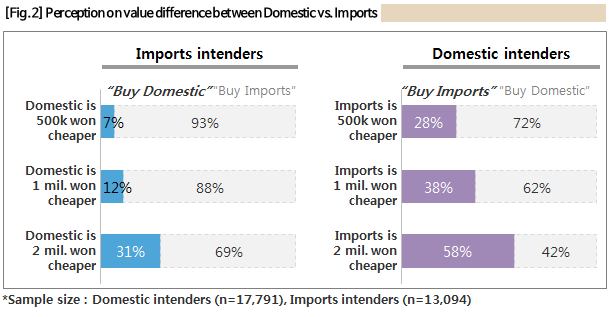
In order to find out the gap in consumer felt value, people were asked about whether to switch the car, when the not-preferred car is 500k won, 1 million won or 2 million won cheaper. Among imported car preferred people, the intention to buy domestic car when the price is 500k won, 1 million won or 2 million won cheaper had increased to 7%, 12% & 31% [Figure 2]. That is, even at 2 million won cheaper price, switching to domestic car was only 3 out of 10 people. |
|
On the other hand, among domestic car preferred people, the intention to buy imported car when it is cheaper had rapidly increased to 28%, 38% & 58%. This indicates that seven out of 10 imported car preferred people consider imported car as having more value at 2 million won or over, while 6/10 of domestic car preferred people consider the gap as 2 million won or less. |
|
 |
|
Imported car has been evaluated as having value for money in spite with cost and A/S related serious weaknesses. And that is believed to attract consumers into the imported car market. If imported cars get a competitive edge in terms of price also, the speeding of Imports will be accelerating even more. In the past, the competition was among 5 domestic brands with 40 to 50 models. But now the market became a battle ground of over 20 brands with hundreds of models. The battle changed from local conflict to all-out war, and there is no weapon that has destructive power as price. |
|
There was a diesel scandal of Volkswagen in September, and there was a forecast that the problem was not a just a matter of Volkswagen but will spread to all imported cars’ problems beyond the entire German cars or diesel-powered vehicles. Volkswagen Group, which experienced a serious slump in October (including Audi), sold a whopping eight thousand three hundred or more in November by carrying out large-scale discount sales. It was a new sales record for one month. Tiguan, which announced a 19% discount or 60 months interest-free installment, won the title of continuous best-selling imported car following 2014. It can be said as a tremendous track record. Volkswagen announced that the 60-month interest-free installment is continuing in January also. It revealed the real intention of Korean consumers again who cling to personal gain than a just cause. |
|
Advancement of imported cars with performance for price at front is unobstructed. Imported cars are now creating a situation to compete with price in addition to the performance. What kind of selections will Korean consumers make? |
|
================================== |
|
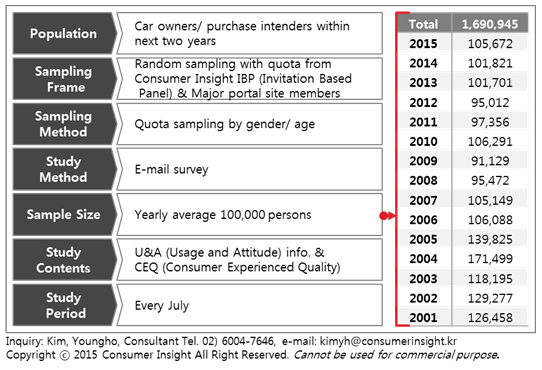
♦ Reference : 「Consumer Insight」 Annual Automobile Syndicated Study Outline
The contents was excerpted and summarized from the results of annual ‘Automobile Syndicated Study’
conducted by Consumer Insight Inc. in every July since 2001. |
 |
|