|
When consumers view the cars, they not only look into the car. But they take all the various aspects into account including not only the price & quality of car but also the provided services, and the role & activities of the company. The reason for consumers to buy imported cars was because of good quality and value for the price. And then, what is the reason for leaving the domestic cars? That is because they do not like companies rather than car. |
|
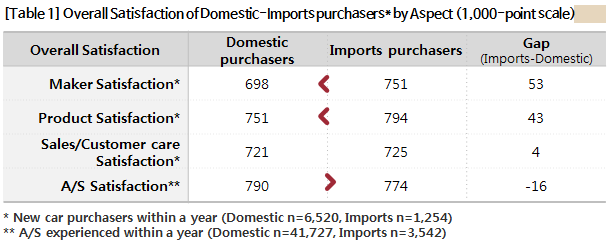
The consumers who purchased new car within one year were asked to evaluate ‘Customer care’, ‘Product quality’ such as the features and performance, experienced ‘A/S service’, and all the aspects (product, service, image, etc.) of the automaker of the car that were experienced while buying and after buying the car. They were asked to grade in a 10-point scale in order to determine Overall Satisfaction of each aspect (1,000-point scale). In the result, imported cars was much higher than the domestic cars in ‘Overall satisfaction for maker’ and automobile ‘Quality’ among the 4 aspects. Domestic cars was somewhat ahead in ‘A/S service’, while in ‘Sales and Customer care’, both were at a similar level [Table 1]. |
|
 |
|
When looking into the gap between domestic and imported, there was a large gap of 53 points in the ‘Maker satisfaction’ between imported cars at 751 points and domestic cars at 698 points. When looking into the relationship with the other scores, the reason for the large gap like this is because of the unusually low ‘Maker satisfaction’ of domestic cars. ‘Maker satisfaction’ of domestic cars is not only less than 700 points alone but also over 20 points lower than ‘Sales/Customer care’, which is the next higher score (721 points). For domestic car, the consumers purchased the car of the company by selection and relatively satisfactory for the car, but they are not satisfied with the company. On the other hand, in the case of imported cars, they have high satisfaction for the product with not low satisfaction for the company. |
|
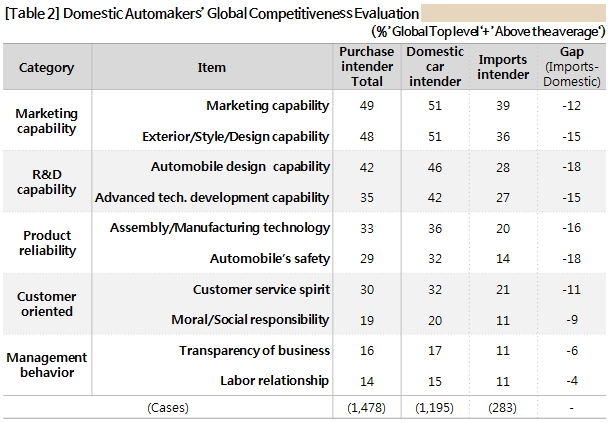
When the consumers, who purchased new car less than one year, are so negative about automaker like that, what about the evaluation of consumers who intend to buy a car? New car purchase intenders within two years were asked about the level of Korean automakers’ global competitiveness in 12 aspects including ‘R&D capability’, ‘Customer relationship’ & ‘Management’. In the percentage of evaluation for top two categories (Global top level + Above-average level) on 5-point scale from entire intenders, ‘Marketing capability’ was the highest at 49%, followed by ‘Design capability’ ( 48%) in order [Table 2]. |
|
 |
|
By major category, ‘Marketing capability’ had the highest evaluation, followed by ‘R&D capability’. ‘Product reliability’ was lower than that, while ‘Customer-oriented’ had more negative response and ‘Management behavior’ had the lowest score. In summary, the domestic auto makers have competitiveness in ‘capability’ aspects but their ‘Product’ is insufficient and ‘Management behavior’ is in backward state. |
|
When viewing by dividing into intenders of domestic cars and imported cars, imported car intenders had much more critical view on domestic automakers in all 12 aspects. In particular, only a few (11%) responded that there are competitive edges in the ethical aspects such as ‘Moral/social responsibility’, ‘Transparency of business’ & ‘Labor relationship’. |
|
This result gives a hint that the reason why Korean consumers do not like the domestic automakers, lies not in the products and services they offer but in the closed nature and disarrayed state of business management. Moreover, domestic car purchase intenders consider domestic cars not because they like the companies with a matter of degrees. That’s because there is no suitable alternative. |
|
In the flip-side of the attitude of many consumers who want to switch to imported cars, there is a feeling of rejection for the domestic automakers rather than dissatisfaction for product & service. It is considered that they have capability but not good in ethical assessment. It is natural for such consumers to assess imported cars more attractive than actual state, and intend to switch upon such assessment. |
|
================================== |
|
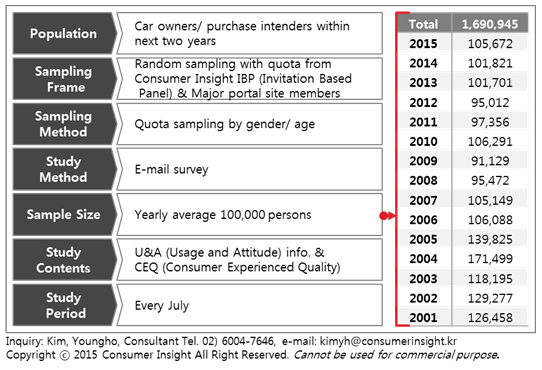
♦ Reference : 「Consumer Insight」 Annual Automobile Syndicated Study Outline
The contents was excerpted and summarized from the results of annual ‘Automobile Syndicated Study’
conducted by Consumer Insight Inc. in every July since 2001. |
 |
|
|