|
Sprint of imported cars is being continued. That is because there are many consumers who believe in Imported cars for good quality and value over the price. However, it is just one of the reasons. Many consumers are more negative about ‘company’ than domestic ‘car’. Imported cars’ excellence in product along with the feeling of rejection for domestic carmaker, both of which is growing the imported car market with synergy effect. |
|
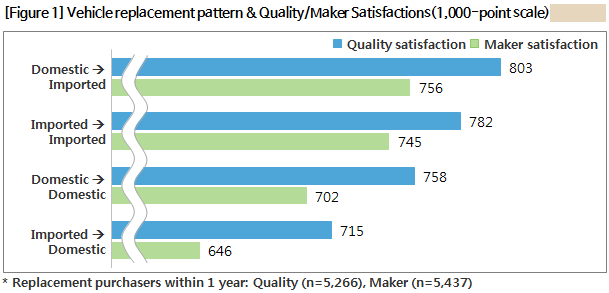
The consumers, who have replaced the car during the past 1 year, were asked how satisfied they are for the current car’s quality and the maker. ‘Quality satisfaction’ and ‘Maker satisfaction’, calculated in 1,000-point scale, were compared by considering the previously owned car. The case with the highest satisfaction in overall was ‘Domestic->Imported’ that switched to imported cars from domestic cars, followed by ‘Imported->Imported’, ‘Domestic->Domestic’, in the order with ‘Imported->Domestic’ at the lowest. [Figure 1] |
|
 |
|
In the survey results, all of the four replacement patterns displayed higher satisfaction for the quality than the maker, while imported car buyers had higher satisfaction than the purchasers of domestic cars. When comparing by replacement pattern, ‘Domestic->Imported’ was the highest in both of the two aspects, quality and maker satisfactions, followed by ‘Imported->Imported’,‘Domestic->Domestic’and‘Imported->Domestic’,inorder. ‘Imported->Domestic’ was lower than the opposite case ‘Domestic->Imported’ by 110 points in Maker satisfaction and by 88 points in Quality satisfaction. Why ‘Imported->Domestic’ has such low satisfactions for the Maker and Quality with large gaps requires a thorough investigation. |
|
In order to confirm that in which aspect of the quality image and maker image there are gaps between domestic cars and imported cars, six questions for each of the models and the makers were presented to the consumers, who purchased a new car within three years. After scoring on 10-point scale, the rate of 8 points or over was summarized as satisfaction. |
|
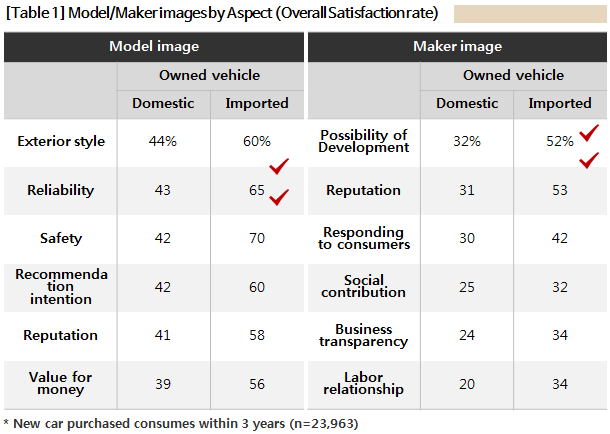
The overall result was the same as the previous one, the higher model image than maker image. Regardless of Domestic and Imports, all six questions of ‘Model image’ were higher than the six ‘Maker image’ items. In addition, there was a large gap between imported car owners and the domestic car owners. In almost all the questions, the positive evaluation of imported car owners was higher by 10%p or over [Table 1]. |
|
 |
|
When comparing the satisfaction rate of each image aspect, the gaps between domestic and imports were remarkably large in both images of ‘Model’ and ‘Maker’. The satisfaction rates of domestic cars in the six ‘Model’ images ranged from 39% to 44%, having large gaps with imported cars ranging from 56% to 70%. The highest of domestic (Exterior style at 44%) was 12%p lower than the lowest of imports (Value for money at 56%). In ‘Safety’ aspect, imported cars was at 70%, which is the highest among all the evaluations with the largest gap with domestic (28%p), presuming what is the greatest strength of imported cars. |
|
In six ‘Maker images’ also, domestic ranged from 20% to 32%, while imported ranged from 32% to 53%, displaying the lowest of imports at the same level with the best of domestic. There was a gap between the imported and domestic to the extent of different class, and the different was greater in the model images. |
|
The question items with over 20%p gap between the domestic and Imports were ‘Safety’ (28%p) and ‘Reliability’ (22%p) in the quality area of ‘Model image’, and ‘Reputation’ (22%p) and ‘Potential for development’ (20% p) in ‘Maker Image’. In other words, imported car owners are considering the quality of domestic cars as particularly vulnerable in safety and reliability aspects compared to domestic car owners, and viewing domestic car companies as having not good reputation and no bright future. |
|
The questions with the lowest evaluation were labor-relationship (20%) and business transparency (24%) of domestic carmaker. Those aspects had the lowest evaluation in Global competitiveness evaluation (see 16 ? Special issue 03: Which one should be blamed? Product or Brand?) also that re-confirms the basis of the consumers’ feeling of rejection for domestic cars lies on the management behavior of automakers. |
|
The reason for consumers gathering to imported cars is because of the powerful attraction factor of value for the price in the quality of imported cars, along with the dissatisfactory management behavior of domestic automakers, working as an avoidance factor at the same time. In the formation of such a consumer environment, the influence of the recent ‘Domestic->Imported’ or ‘Import->Domestic’ switching experienced consumers is extremely important. Their assessment is convincing in terms of recent experience in both of domestic and imported cars, and would be fairly reliable information to the people around. People who switched to imported cars from domestic have a possibility to talk actively about how good their new cars are and how they are satisfied. In opposite case, there is a possibility to talk about how dissatisfied they are now and regret. |
|
Recently there are increasing numbers of customers who are going back to domestic cars from imported cars. There are some people welcoming it as the recovery sign of domestic cars’ competitiveness. It’s not certain why they went back to domestic cars, but the possibility of those people to be a help domestic car appears to be thin. They have a possibility to send more people to imported cars by pouring out dissatisfactions for the newly bought domestic cars and the makers, while professing themselves as living witness. |
|
================================== |
|
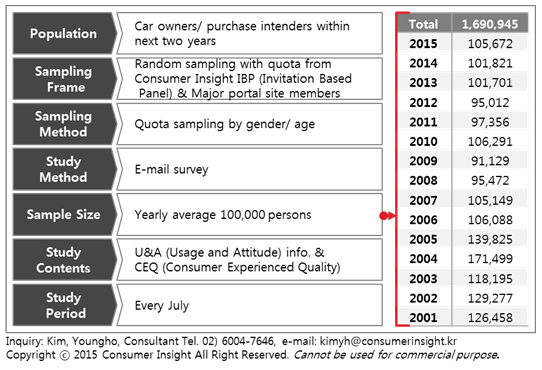
♦ Reference : 「Consumer Insight」 Annual Automobile Syndicated Study Outline
The contents was excerpted and summarized from the results of annual ‘Automobile Syndicated Study’
conducted by Consumer Insight Inc. in every July since 2001. |
 |
|