|
The biggest weakness of the domestic car evaluated by consumers is ‘Safety’. There are several importantly considered specific features by consumers such as vehicle price, fuel economy, design, etc. However, the biggest difference in comparison with imported cars always happens in safety. The reason why safety is important is not because of the stability under normal driving situations, but because of the faith that it can reduce how much injury or risk in special circumstances. The consumers’ confidence on the safety of domestic car had been far below of imported cars, and the main cause was airbag. |
|
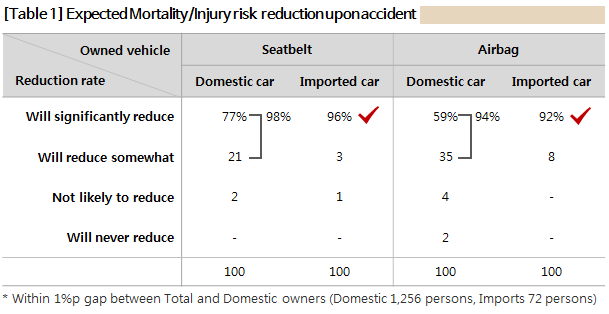
For the typical user protection device of vehicle, seatbelt and airbag, the drivers (1,329 persons) were asked about how much they expect ‘the seatbelt and airbag in your car will reduce the risks from accident such as injury/death. As a result, in the case of domestic car owners, the answer of ‘Will significantly reduce’ appeared as 77% for seatbelt and 59% for airbag [Table 1]. On the other hand, imported car owners had 19%p and 33%p, respectively, higher rates of ‘Will significantly reduce’ with seatbelt at 96% and airbag at 92%. That was the similar size of ‘Significantly + Somewhat’ of domestic cars (98% & 94%, respectively). |
|
 |
|
This results indicate that ▴ imported car owners had higher trust on the safety equipment than domestic car ▴ imported cars had no big difference between seatbelt and airbag ▴ domestic cars had much higher trust on airbag than seatbelt. In other words, domestic cars are questionable for both seatbelt and airbag, but airbag is a larger problem. |
|
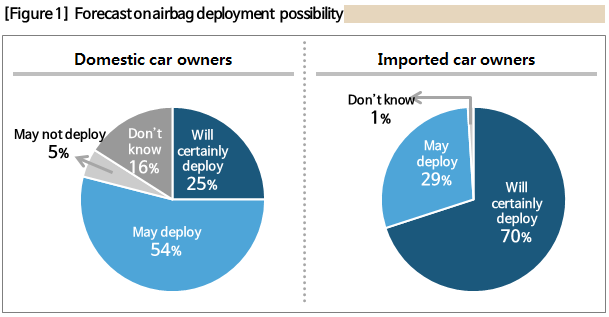
‘Will the air bag equipped in your car deploy upon accident’ was asked. As a result, only 25% of domestic car owners said ‘Will certainly deploy’, whereas 70% of imported cars said so [Figure 1]. Only 1 out of 4 domestic car owners trust airbag, while a majority (54%) had a hopeful outlook as ‘May deploy’. Beside of them, 16% said ‘Don’t know’ and 5% said ‘May not deploy’, indicating only a handful people having faith on airbag. |
|
 |
|
On the other hand, 99% of imported car owners said that ‘Will certainly deploy (70%)’ or ‘May deploy (29%)’, vividly displaying the significant trust on airbag. |
|
Consumers, in fact, did not know much about airbag. 45% didn’t know how many airbags are equipped in their car, while 54% didn’t know what kinds of airbag (for example; SRS, etc.) are there. However, more important than such knowledge is trust. Regardless of the number and type of the airbags, it should be believed to protect me in case of emergencies. |
|
Hyundai created an official blog, ‘Hyundai says’, and opened a section called ‘Misunderstanding and truth’. It appears to be an attempt to resolve the ‘Misunderstanding’ of consumers by revealing the ‘Truth’. In this blog, 2 out of 6 subjects that had been dealt with until now are about airbag, and the most recent one was ‘Hyundai airbag doesn’t pop up?’ Hyundai Motor is also well aware of the consumers’ distrust on airbag. |
|
Being unjustly misunderstood means suffering unfairness. Hyundai Motor announced that its airbag is superior against other domestic automakers or imported cars but unfortunately not being recognized by quoting the documentation of 2012 Korea Consumer Agency. The trust rate of Hyundai ? Kia owners on airbag deployment shown in this study is 23%, which is lower than domestic competitors (31%). Unfortunate thing is that it was not evaluated at 8%p lower than domestic competitors, but it had not reached 1/3 lev el of imported cars at 70%. More unfortunate is how it has received such distrust with excellent products by treating consumers in what kind of relationship. |
|
However, the party really suffering from unfairness is the consumers. That’s because they have to purchase untrustworthy airbag at expensive price unconditionally, and drive the car with the expectation of ‘may deploy, probably will be helpful’ as collateral in case of an emergency. They are the consumers who must hope the worst case not happening to them, while looking at the unbelievable elucidation of automaker on not deploying airbag. |
|
Their interest in imported cars’ airbag at 70% trust rate is justifiable |
|
================================== |
|
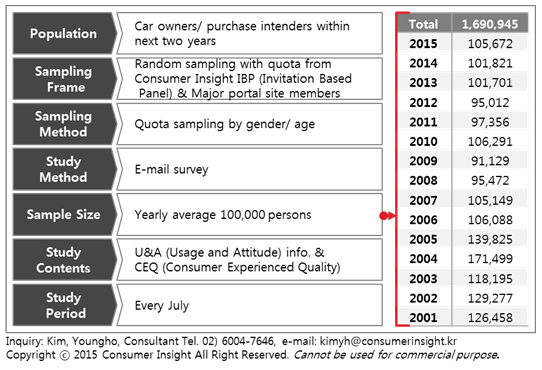
♦ Reference : 「Consumer Insight」 Annual Automobile Syndicated Study Outline
The contents was excerpted and summarized from the results of annual ‘Automobile Syndicated Study’
conducted by Consumer Insight Inc. in every July since 2001. |
 |
|