|
In terms of being able to check the status of the problem visually, corrosion is significantly different from the problems such as function and performance. There is a little room for discussion. Whether there was corrosion on the vehicle and where the corrosion happened were asked to the consumers. As a result, Hyundai-Kia cars had more corrosion than imported cars as a matter of course, as well as 3 domestic competitors. The gap with imported cars was so large that it’s hard to tell it’s able to compete in overseas. If there are large gaps in the corrosion problems occurred by domestic automakers, it should be accountable for the difference in the raw materials or processing steps, rather than use environment or management. |
|
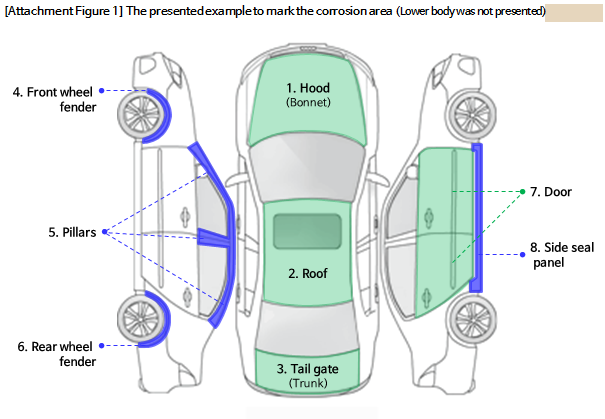
Consumer Insight along with Korean Automobile Consumers Union (President, Lee, Jeong-Joo) conducted a joint syndicated study (fielded in July 2015), which asked 35,370 consumers who owned new car for 5 years or over about △ whether to have corrosion on painted face (exterior plate) or lower body △ on which area the corrosion occurred among 10 areas including fender and lower body [Attached Figure 1]. |
|
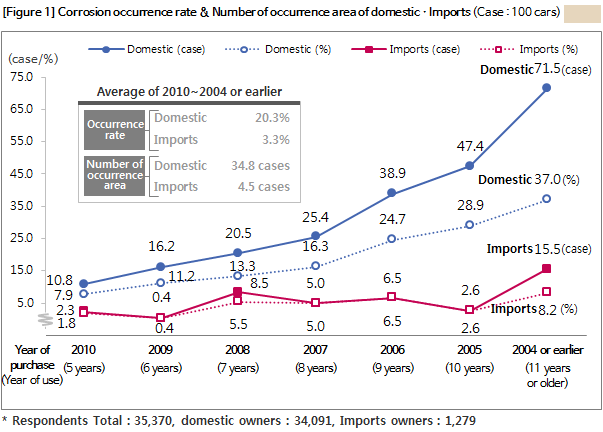
First of all, corrosion experience rate and number of experienced corrosion (the number of occurrence area) were calculated by dividing into imported cars and domestic cars. The corrosion experience rate of the entire respondents, whose ownership period is 5 years or over, were 20.3% for domestic cars and 3.3% for imported cars, showing domestic cars with corrosion at six times of imported cars [Figure 1]. The number of experienced corrosion (per 100 cars) were also average 34.8 cases for domestic cars and 4.5 cases for imported cars, displaying 8 times more domestic cars. These differences show the huge gaps in corrosion aspect between imported cars and domestic cars that is meaningless to compare. |
|
 |
|
The corrosion occurrence rate and the number of cases had increased as the used year increases, in other words, longer purchase time. In the number of corrosion occurrence cases, five years used (purchased in 2010) imported had 2.3 cases, while domestic had 10.8 cases per 100 vehicles, displaying 5 times more domestic cars. This trend has followed continuously, and among over 11 years used cars (purchased in 2004 or earlier), imported had 15.5 cases, while domestic had 71.5 cases, also displaying 5 times more domestic cars. Therefore, in overall, the corrosion problems of domestic car can be five times of imported car. |
|
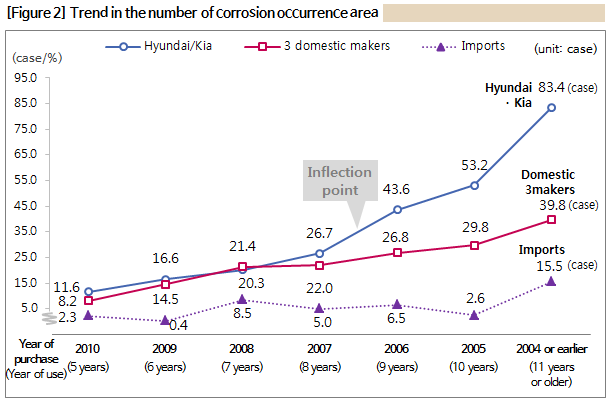
The number of corrosion occurrence cases was arranged by dividing into Hyundai-Kia, 3 domestic carmakers and imported cars. Hyundai - Kia had average 83.4 cases among the 11 years or older cars that were greater than any other competitors [Figure 2]. Hyundai-Kia cars manufactured before 2004 had twice more corrosion occurrence cases than the 3 domestic carmakers (39.8 cases) and five times more than imported cars (15.5 cases). It clearly indicates that there were more problems regardless whether it’s on steel plate or in the painting and rust-proofing process. |
|
 |
|
Hyundai-Kia, which had much more number of corrosion cases than 3 domestic carmakers, has reduced to the similar level with them since 2007. And that partially supports the official position of Hyundai-Kia, saying the difference of steel plate between exports-domestic had been removed since 2007. However, the gap with imported cars is still outstanding, not appearing as at equal level with imported brands for competition in overseas. |
|
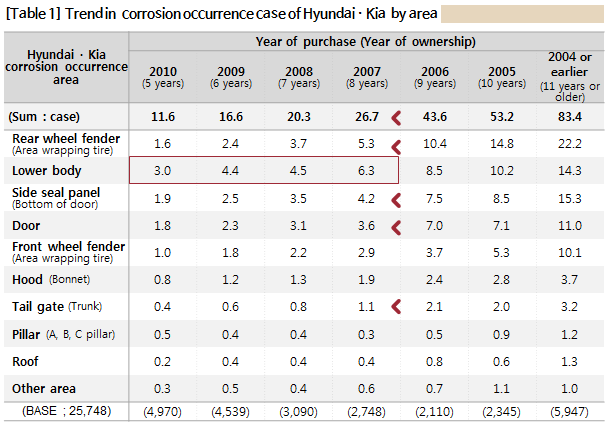
The number of corrosion occurrence cases by purchase year of Hyundai-Kia cars was divided into occurrence area for analysis. When looking at the gap between 2006 and 2007 that can be called an inflection point, Hyundai-Kia had reduced by 40% with a large gap with other carmakers that had reduced by around 20%. By area, ‘Rear wheel fender’, ‘Side seal panel’, ‘Door’ and ‘Tail gate’ areas had sharp reductions to half the level [Table 1]. This result indicates that there was a clear improvement effort with not so small outcome since 2006 but that was not full-scale improvement. It is estimated that there were improvements around a particular area and particular process. Although Hyundai-Kia Motors had improved to the similar level with the average of other 3 domestic carmakers since 2007, there is a still too far distance with the imported cars to be compared. |
|
‘Lower body’ was not the area with high number of corrosion but since 2007, it emerged as the highest corrosion area. In other words, the improvement in 2006-2007 was done around the visible outer plates, while the hard-to-confirm lower body seemed to be excluded. However, lower body corrosion of this study was significantly underestimated compared to reality. In the course of surveying, unlike other areas, lower body was not presented as one of the answers (Refer to attached Figure 1). If it was under same condition, it would have a far more pointed outs. Furthermore, when considering the fact that check-up opportunities are limited unlike other areas, there would be a lot more problems of lower body corrosion. |
|
 |
|
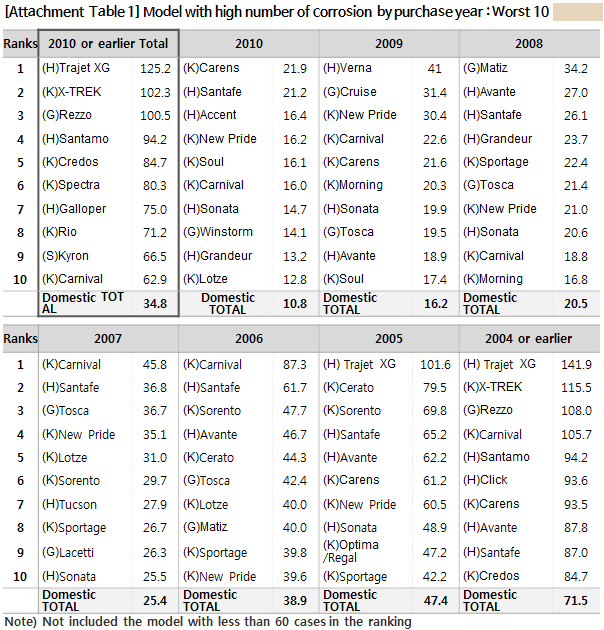
By vehicle model, the models with the highest number of corrosion area by purchase year include ▴ 2004 or earlier & 2005 Hyundai Traje XG ▴ 2006 & 2007 Kia Carnival ▴ 2008 GM Korea Matiz ▴ 2009 Hyundai Verna ▴ 2010 Kia Carens [Attachment Table 1]. Among the entire models currently in service, Hyundai Traje XG & Kia X-Trek were accounted for the disgraceful 1st and 2nd places. |
|
Hyundai created an official blog, ‘Hyundai says’, and opened a section called ‘Misunderstanding and truth’. It appears to be an attempt to resolve the ‘Misunderstanding’ of consumers by revealing the ‘Truth’. In this blog, the first 4 out of 6 subjects that had been dealt with until now are about steel plate, and the very first one was ‘Corrosion’. The ‘Misunderstanding’ to be resolved with the highest priority by Hyundai in relation with consumers is known to be corrosion in this perspective. |
|
The study result supports that it is more of the ‘Truth’ than the ‘Misunderstanding’ that the perception of consumers believing ‘different steel plate for domestic demand from exported’. If the domestic demand and exported are the same, Hyundai has competed in overseas until now with the cars having five times more corrosions than imported cars. In the United States, Hyundai offers 7 year warranty for penetrating corrosion. Offering this kind of warranty with the same car in domestic market is unrealistic. Or else, the story in which foreign brands have exported the cars with 1/5 less corrosion than domestic cars to Korea only doesn’t make sense at all. |
|
Recently a high official of Hyundai Motor said, ‘the steel plate for North America have used more galvanized plates because of corrosion’ and ‘there is no difference in steel plate between exported and domestic demand by applying 80% galvanized plate in domestic demand vehicle from this year (2015)’, which brought a great disturbance. But it was calmed as a happening by the urgent clarification as ‘confused comment’ from the public relations department, and no difference from 2007 was established as ‘Truth’ again. |
|
The real ‘Truth’ is a concern. Even if as a ‘confused comment’, it is a wish to be a ‘Truth’ that there is no difference since 2015. |
|
================================== |
|
 |
|
 |
|
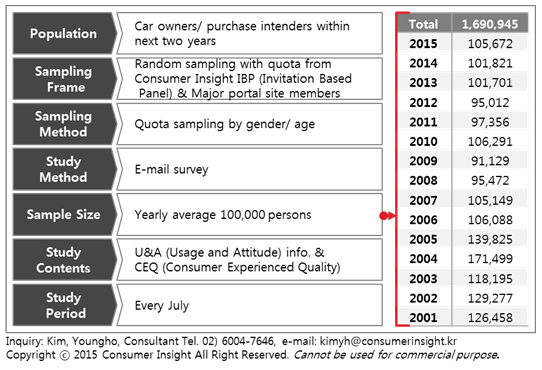
♦ Reference : 「Consumer Insight」 Annual Automobile Syndicated Study Outline
The contents was excerpted and summarized from the results of annual ‘Automobile Syndicated Study’
conducted by Consumer Insight Inc. in every July since 2001. |
 |
|