|
Time and money are all important to consumers. Imported car customers tend to secure time even at the cost of their own money instead of saving money by spending their time. Unlike customers’ needs as such, imported cars’ after sales service (hereafter ‘A/S’) took by far longer, which was more visible with companies with low customer A/S service satisfaction. A long waiting time is the Achilles heel of the imported car A/S service.
|
|
In Consumer Insight’s 2016 “Annual Automobile Syndicated Survey”, there were about 38,000 customers who had received A/S service from either vertical or authorized or partner service centers of their car brands’ (vertical service centers only for imported cars). We selected parts of the study regarding service time and compared them between imports and domestic cars. Both domestic and imported cars were put into high (above average) vs low (below average) A/S service group, respectively, and the study confirmed on any difference among the groups in the 5 areas of ‘reservation process,’ ‘car registration process at A/S service center,’ ‘maintenance process,’ ‘part supply,’ ‘total service time.’
|
|
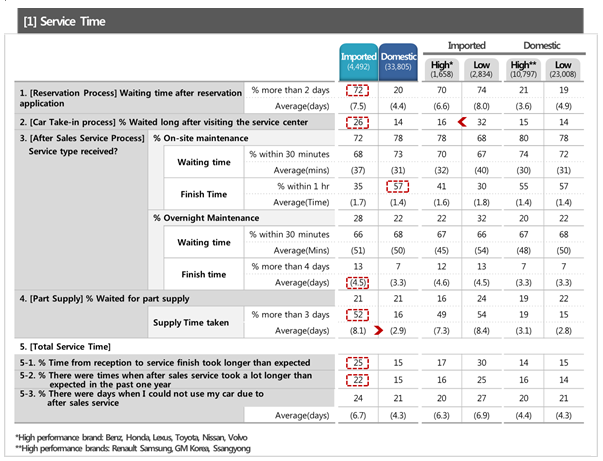
1. A/S service reservation process: Regarding the reservation process, AutoInsight’s previous issue (Automobile Report 16/17-02) already reported that phone reservation was the core of the booking process and there was a big difference between the two car groups of different origin with the rate of "booking 3 or more days later" standing at 72% for imported cars and 20% for domestic cars, and that when it comes to "average waiting days," it took 7.5 days for imported cars and 4.4 days for domestic cars, indicating that imported cars had to wait more than 3 days longer to get serviced.
|
|
The phone reservation process of imported cars is a matter of improvement at the quickest time [Table 1].
|
|
 |
|
2. Car registration process at A/S service center; The customers’ answer to ‘had to wait long from the A/S service center visit to car registration for maintenance was 26%, almost double the domestic cars’ (14%). Also, the response to the same question was 32% for the low service performance group of the imported cars, which was twice as high as the high performance group of imported cars. The car registration process for maintenance is a start of A/S service, thus, determines customers’ impressions of the brands. It is likely that the problems of imported cars with below average service satisfaction might have been started from here. No difference was found between high vs low service group of domestic cars, though.
|
|
3. Maintenance process; When maintenance was divided into on-site maintenance and overnight maintenance, there was some difference in service time between import and domestic. In case of on-site maintenance, completing the service within an hour was 35% for imports and 57% for domestic, meaning more time was needed for imported cars’ service to be completed. As for overnight maintenance service, it took longer for imports as the average days for the service was 4.5 days for imports and 3.3 days for domestic. There was almost no difference within the high and low service group of both imports and domestic cars in the maintenance process.
|
|
4. Part Supply; The customers’ response to ‘had to wait for car parts’ was the same with 21% for both imported and domestic, but there was a big difference in the length of time. The rate of ‘waited more than 3 days’ was only 16% for domestic cars, but more than half of the imported car customers answered the same at three times as high a rate as 52%. The average waiting days was 2.9 days for domestic and 8.1 days for imports, which is nearly three times the domestic’s. With regard to service time, the biggest weakness of the imported car was the waiting time for parts supply, and the difference between the high and low service group of the imported cars was not so big, which implies that the problem is common to all import cars.
|
|
5. Total A / S service time; We looked into A/S services that the customers experienced recently and in the past one year. In the case of the recent A / S service experience, the customers’ answer to " took longer than expected from reception to completion" was 25% for imports and 15% for domestic cars, with the imports taking longer. The imported cars also needed longer time than their domestic counterparts in ‘took a lot longer than expected’ with 22% against 15% for domestic cars, ‘unable to use the car due to A/S service with 24% and 21% for imports and domestic cars, respectively, while the imported car customers could not use their cards 6.7 days on average against 4.3 days for domestic car users. Customers’ experience both in their single recent service and total one year experience proved that A/S service took longer with imported cars.
|
|
A close look at the whole A/S service process confirms that imported cars are inferior. The most serious of these are 'phone reservations' and 'supply of parts'. Particularly, time for parts supply of imported cars takes about three times as long as domestic cars. This is a common problem among imported cars because there is no difference between the high vs low service performance group of imported cars regarding this matter. In terms of A / S service time, the most important issue for all imported car companies to address is the smooth part supply. It should be borne in mind that imported car customers are willing to secure more time even at the cost of their own money.
|
|
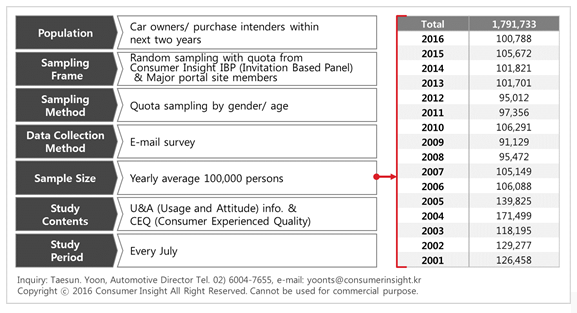
This study results came from the 16th wave (conducted in July 2016) of a large-scale annual ‘Automobile Syndicated Study’ with 100,000 samples, which was launched in 2001 by Consumer Insight, an automotive specialized research firm.
|
|
================================== |
|
◈ Reference: 「Consumer Insight」 Annual Automobile Syndicated Study Outline |
The contents was excerpted and summarized from the results of annual ‘Automobile Syndicated Study’
conducted by Consumer Insight Inc. in every July since 2001. |
 |