|
Imported cars continue to lead the way. Despite the fatal wound from the diesel gate in September, 2015, the imported cars have been recovering fast. The streak of the imported cars’ growth is because the cars from abroad are more attractive and competitive. As of the last year, the imported cars were behind their domestic counterparts only in the A/S competitiveness out of the 10 competiveness evaluation areas. However, this year, the imported cars rose to an incomparable position against the domestic cars by overcoming their weakness in the A/S areas as well. The imported cars are building up their competitiveness in many aspects and their dominance is likely to continue. |
|
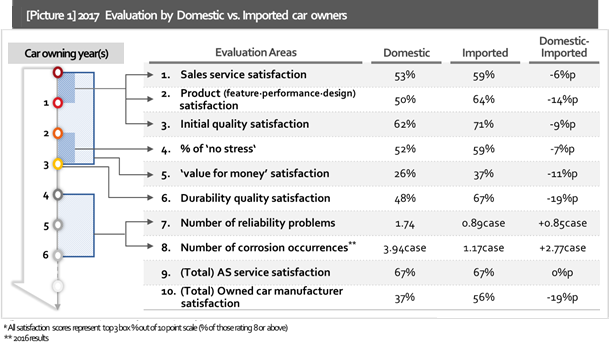
‘Annual syndicated automobile study’ that ConsumerInsight has been running since 2001 has been tracking customer experiences and sentiments over time since they bought their cars, with a precision. The study identified 10 satisfaction areas that customers are more likely to be interested, depending on their car owning and driving periods, and compared the competitiveness of the domestic and imported cars [Picture 1]. |
|
 |
|
1. Sales service satisfaction; First of all, the study asked customers that had bought their cars within the past 1 year how satisfied they were with sales service at the point of the car purchase and customer care post the sales in a 10 point scale. Some 53% of the domestic car buyers rated 8 points or above while imported car owners’ satisfaction turned out to be 6% points higher at 59% on the same measure.
By brand, Renault Samsung ranked the 1st in the 16 consecutive years on sales service Index (SS) that is indexed to 1,000 points, with Lexus ranking the 1st among the imported cars. |
|
2. Product satisfaction; Those who bought their cars within the past 1 year were also asked about their cars’ attractiveness (TGR: Things Gone Right) or their satisfaction with their cars in terms of performance·feature·design. The results showed that the imported cars were 14% points more satisfactory than the domestic cars, with 64% of the imported car owners rating 8 point or higher while the rating stood at 50% among the domestic car buyers. Product attractiveness is one of the areas where the imported cars are relatively very competitive, compared to the domestic cars. Hyundai came up as the number one brand among the domestic cars with Benz doing better than any other imported cars on the measure as well. |
|
3. Initial quality satisfaction; The owners of new cars that were bought less than a year ago were asked if they had experienced any defect·breakdowns·problems during their first one year use of their cars and then how satisfied they were in a 10 point scale. The results showed some 9% point difference with the imported cars (71%) outperforming their domestic counterparts (62%) in the initial quality satisfaction (measured in % of rating 8 point or above). The fact that the difference increased significantly for the imported cars from 4% last year to 9% this year hints that the domestic cars have become less competitive against the imported, which is because the initial quality of new domestic cars that were recently introduced was not stable.
The number of initial quality problems (number of problems per hundred cars) was also looked into in order to compare among brands. Hyundai showed the least number of problems for the last 6 years in a row, with Lexus also outperforming the other brands (in the 2 consecutive years) among the imported cars. |
|
4. Quality stress; The study asked those who bought their cars 2 to 3 years ago about how stressed they had been with their car quality and service. 52% and 59% of those domestic and imported car owners, respectively, claimed that they had not been particularly stressed (rating 8 point or above). The difference of 7% point shows less stress among the imported car owners (9% point difference for the last year). Hyundai was rated as the least stressful car among the domestic whereas Lexus was rated as such among the imported cars. |
|
5. ‘Value for money’ satisfaction; The study asked customers what they thought about costs for car purchase and maintenances (e.g. price, fuel efficiency, maintenance cost, A/S cost, used car price, etc) and how satisfied they were in terms of ‘overall value for money’ of their cars, factoring in all the maintenance costs mentioned above. Value for money satisfaction was 26% for the domestic cars with the imported cars standing at 37% on the measure, 11% points up for the imported cars. In general, smaller and cheaper cars were evaluated as more satisfactory on value for money. However, the story was different when domestic and imported cars were compared with each other. Considering the average car price of imported cars was KRW 61,300,000 doubling that of the domestic cars, priced at KRW30,800,000 on average, the value for money of the domestic cars should be rated as better than the imported cars’, but the results did not turn out to be so. It is worth it to look into why the domestic cars were low in value for money against the imported cars when the imported cars were twice more expensive than the domestic cars and customers’ complaints and dissatisfaction were more prevalent for the imported. The brands with the best value for money were GM Korea and Lexus among domestic and imported cars, respectively. |
|
6. Durability quality satisfaction; Those who had been using their cars for 3 years after their car purchase were asked about what defects·breakdowns·problems they had experienced and then requested to indicate how satisfied they were with their car quality or durability (durability satisfaction). The study learned a big difference of 19% points between the domestic(48%) and imported cars (67%) on the measure. The difference was the largest in all the quality indexes of this report, and the difference was the same last year. The result truly reflects customer perceptions of durability as one of the most serious weaknesses that the domestic cars have.
Hyundai was rated as a least defect/problem-carrying domestic brand (ranking 1st in the 2 consecutive years) and Lexus was so among the imported cars (for the last 2 years in a row). |
|
7. Number of reliability problems; The study showed those who owned their cars for 5 years on average (4 to 6 years) 19 problem areas such as engine, noises, brakes and more and asked them to point out everything they perceived as abnormal even for their car years. The number of the indicated problems was turned into reliability index. On average, some 1.74 problems were found for the domestic cars, almost doubling the imported cars of which some 0.89 problems were pointed out. This index is a product quality indicator, following durability evaluation (on 3 year car ownership), and the finding shows customers’ lack of confidence in using the domestic cars with reliability in long terms. Along with durability issues, reliability is another area that the domestic car industry should take very seriously. On the reliability index, GM Korea outperformed the other domestic brands and Honda did the best among the imported cars as well. |
|
8. Number of corrosion occurrences; The pictures of car exterior and lower body were shown to customers who were then asked to indicate the areas of corrosions, and then the number of corrosions indicated were indexed. Among those who owned their cars for 5 years on average (4 to 6 years), the domestic cars were found to have 3.94 corrosion areas on average, some 3.4 times higher than the imported cars that were learned to have 1.17 corrosion occurrences. The difference between the domestic and imported cars was the largest in all the indexes that were reviewed, and rust/corrosion was the most mentioned as abnormal of the 19 problem areas presented to the customers for reliability evaluation. It is well implied that corrosion is the core to durability and reliability issues of the domestic cars. |
|
9. AS satisfaction; Customers who had A/S service in the past 1 year from service centers run by their car manufacturers showed the same satisfaction of 67% for both domestic and imported cars for the first time ever. AS service was the only area where the domestic cars used to outperform the imported cars (2% points up for the domestic cars as of the last year), but now it is not true anymore.
The imported cars have overcome this only problem that had been pointed as chronic to them and came to show no weakness in customer evaluations.
By brand, Renault Samsung did the best among the domestic cars with Toyota ranking the 1st among the imported cars for the first time on AS service evaluation (CSI), indexed to 1,000 points. |
|
10. Owned car manufacturer satisfaction; Regardless of how long they owned their cars, new car buyers were asked about how satisfied they were with their car manufacturers. The results were 37% for the domestic cars and 56% for the imported. 37% was the only satisfaction performance below 50% for the domestic cars, and the difference was 19%, which was as large as the difference between domestic and imported cars on durability issues, having dropped down by 4% points since the last year. The results show that customer dissatisfaction was larger with car manufacturers rather than car quality or service, and such a tendency is bigger for the domestic cars. On car manufacturer satisfaction, Renault Samsung stood out to rank 1st and Lexus came on the top among the imported cars |
|
Overall, it looked apparent that imported cars did better than domestic cars in 9 out of the 10 evaluation areas. The imported cars tied with their domestic counterparts on the A/S service satisfaction, but when considering A/S service offered at manufacturers’ vertical centers apart, the imported cars performed better. This is because A/S service at manufacturers’ vertical A/S centers falls quite behind that of appointed or affiliated A/S centers. In fact, domestic cars show no area of better performance, stuck in full of weaknesses. |
|
The biggest weaknesses of the domestic cars in product quality are reliability and durability. Unlike the past, it has become easy to compare among the domestic and imported cars. In particular, the comparison between the two on rust or corrosion that are easy to spot clearly illustrates how vulnerable the domestic cars are. |
|
The imported car sales went over 200,000 cars, accounting for more than 15% of the market, but this is only a beginning. Still, Korea is in an early stage of opening the market with the smallest market share of imported cars in the world. However, it will be inevitable that the market will be skewed toward imported cars if domestic cars continue to stay inferior to their imported counterparts in almost all the evaluation areas. It must be learned what is behind the weak competitiveness of domestic cars and improvements need to be made thereupon. |
|
We must face that it is not product or service but manufacturers themselves that matter the most as the biggest weakness of the domestic cars. Nobody would want to buy a product from a company that they do not like. It is the most urgent to improve customer relationship among any other things. |
|
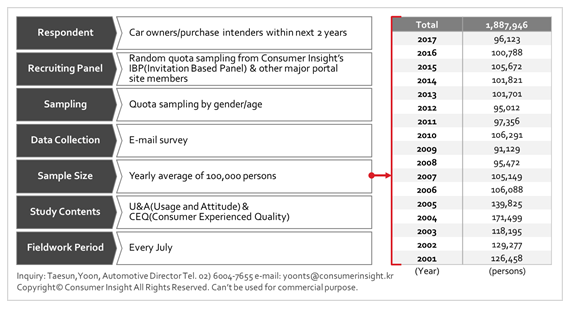
The research results on this report are based on ‘the 17th Annual Syndicated Automobile Study (fielded in July, 2017)’ that ConsumerInsight, an automobile specialized market research firm, conducted since 2001, with the sample size of over 100,000 consumers per study. |
|
================================== |
|
◈ Reference: 「Consumer Insight」 Annual Automobile Syndicated Study Outline |
The contents was excerpted and summarized from the results of annual ‘Automobile Syndicated
Study’ conducted by Consumer Insight Inc. in every July since 2001. |
 |