| For the past one year, the average price that customers had to pay for buying a new car was KRW 30.79 million for domestic cars, and KRW 61.33 million for the imported, which is approximately as twice expensive as the domestic’s. The average amount of discounts or benefits given by a car company or a salesperson was KRW 1.51 million for domestic and KRW 4.04 million for imported, respectively, with the latter having provided 2.7 times more than their domestic counterparts. Since 2013, the average car price of domestic cars has increased by 17% in the past 4 years to exceed KRW 30 million for the first time with the imported cars having risen in their average car price by merely 8%. The brands that offered large discounts (including rewards) were GM Korea among the domestic cars, Ford and BMW for the imported cars. | | The study asked those who bought a new car within the past one year since 2013 to 2017 about actual car price they paid and the amount of discounts/benefits that they received either from car companies or sales reps. Based on this, [Picture1] below summarizes car price, discount price, and discount rate of both domestic and imported cars. According to the results of 2017, the average car price was KRW 30.79 million for the domestic and KRW 61.33 million for the imported, which is about twice as much as the domestic’s [Picture1-1]. The average discount price of the domestic was KRW 1.51 million, on average, with that of the imported cars’ standing at KRW 4.02 million, 2.7 times more than the domestic’s [Picture1-2]. Likewise, the imported cars offered a higher discount rate of 6.6% than their domestic counterparts that provided the same at 4.9% [Picture1-3]. | | 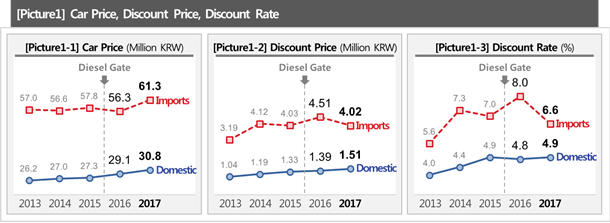 | | The trends in the past 5 years show that the domestic cars have increased their car price, discount price, and discount rate in a steady manner. The domestic cars increased their car price by KRW 4.6 million since 2013 whereas they ceased to increase the discount price only by KRW 0.47 million, a one tenth the increased car price. It is hinted that the domestic cars have deluded customers by raising the discount price only slightly alongside their sharply increased car price. The imported cars were heavily influenced by the Diesel Gate that broke out in September, 2015. In 2016, the imported cars looked to have no other choice but to adopt the strategies of lowering their car price while increasing their discount prices. In 2017, however, they switched to the other way of raising their car price while lowering their discount price, which indicates their confidence that the diesel gate will be no longer a barrier to their car sales. | | In automobile, a price strategy varies greatly by brand. Among the domestic cars, GM Korea whose focus is largely on mini cars runs a price strategy that differs greatly from the other 4 domestic brands. The brand maintains its price structure where their car price is low but their discount amount and discount rate are the largest. The GM Korea`s discount rate of 6.9% shows a big difference from the other 4 brands’ that range from 4.4%~5.0%. The brand’s average car price is two thirds that of Hyundai’s with its discount price yielding lower profits. The running of the brand’s price strategy like this has been a main factor that has aggravated the brand’s profits since 2013. | | When comparing the car price of the imported brands (8 brands) with more than 60 cases, we see that Land Rover was the most expensive (KRW 82.59 million), followed by Benz (KRW 71,29 million), on average, with Ford (9.7%, KRW 5 million) and BMW (8.0%, 5.35 KRW million) standing out as the brands that provided the largest discount rate and discount price. Honda (4.2%) and Lexus(4.7%) offered the least in discount rate. | | Among all products, it is hard to find such a complicated price structure as automobile’s. In addition, depending on economic and competition situations, all of manufacturers, dealers, agencies, and salespeople take a war by changing their sales conditions every month. Of course, there is a limit to the data of this report as it depends on consumer`s memories. However, when considering the fact that the sales data is often contaminated with all hidden costs and revenues, this report could be the optimal source to resort to when it comes to understanding the state of price competitions. | | The research results on this report are based on ‘the 17th Annual Syndicated Automobile Study (fielded in July, 2017)’ that ConsumerInsight, an automobile specialized market research firm, conducted since 2001, with the sample size of over 100,000 consumers per study. | | ================================== | | ◈ Reference: 「Consumer Insight」 Annual Automobile Syndicated Study Outline | The contents was excerpted and summarized from the results of annual ‘Automobile Syndicated
Study’ conducted by Consumer Insight Inc. in every July since 2001. | 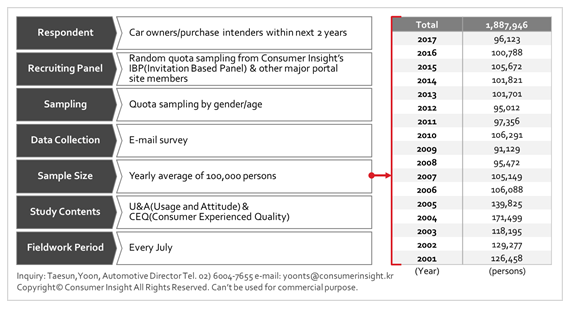 | |